
On this page
- Morpheus8 vs other skin tightening treatments at a glance
- What does Morpheus8 do?
- How does a Morpheus8 treatment work?
- What does the “8” in Morpheus 8 mean?
- Is Morpheus8 FDA-approved?
- What did the FDA warn about in 2025?
- How many sessions do you need, and how long does it last?
- Morpheus8 vs microneedling, Thermage and Ultherapy
- Can you do Morpheus8 at home?
- What real patients say it feels like
- Where to go from here
Quick answer: Morpheus8 is a fractional radiofrequency (RF) microneedling treatment made by InMode. Insulated needles go up to 4mm into the skin on the face and release RF heat at their tips to trigger collagen repair. Most people have 1 to 3 sessions, see the main change around 3 months, and the device is FDA-cleared, not FDA-approved.
We read both of Morpheus8’s FDA clearance files, the FDA’s October 2025 safety notice and two 2026 systematic reviews (one of 20 studies, one of 41), so this page quotes the paperwork instead of the brochure. (Yes, I read FDA paperwork for fun now. No, I don’t want to talk about it.)
Morpheus8 vs other skin tightening treatments at a glance
| Treatment | How it works | Needles? | When results show | What the FDA clearance says |
|---|---|---|---|---|
| Morpheus8 | RF heat released through insulated needles | Yes, up to 4mm on the face | Main change around 3 months | “coagulation/contraction of soft tissue or hemostasis” |
| Regular microneedling | Needles only, no heat | Yes, about 2mm | After 4 to 6 sessions | Varies by device |
| Thermage | RF heat from the skin’s surface | No | Best in about 6 months | “non-invasive treatment of wrinkles and rhytids” |
| Ultherapy | Focused ultrasound | No | 2 to 6 months | “lift the eyebrow” and “lift lax submental … and neck tissue” |
| At-home RF device | Low-energy RF on the surface, used often | No | Modest gains over 12 weeks in one trial | The FDA says RF microneedling “should not be used at home” |
Sources: Morpheus8 clearance K240017, InMode UK tip specs, Claytor Noone Plastic Surgery, Thermage clearance K170758, Ultherapy clearance K134032, AAD on sagging skin, 2022 at-home RF trial, FDA safety notice.
What does Morpheus8 do?
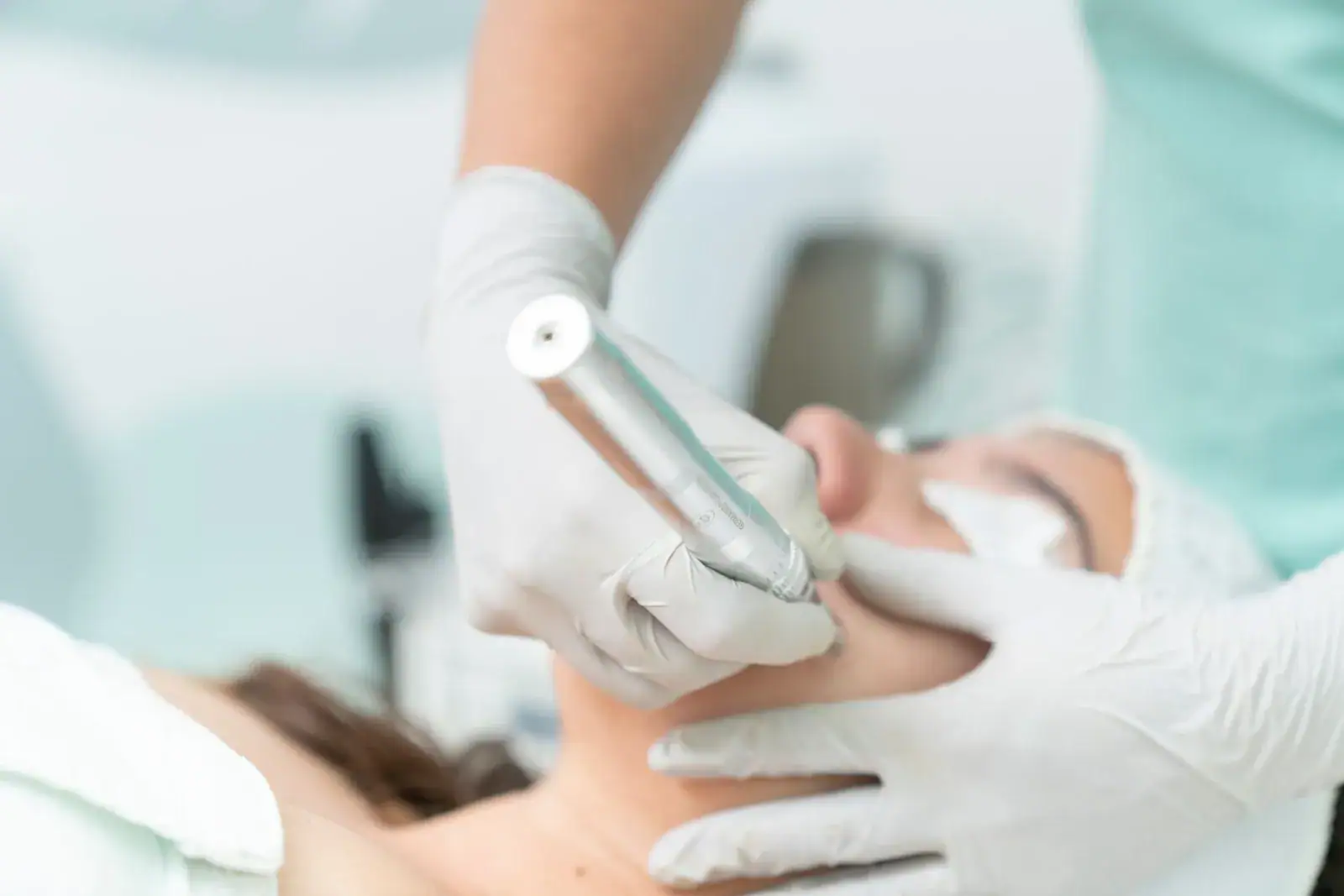
Morpheus8 pushes tiny insulated needles into the skin, then fires radiofrequency heat out of the needle tips. The needles make controlled micro-injuries and the heat warms the deeper layer, and your skin answers both by building new collagen. I read that sentence four times before it stopped sounding like a medieval punishment (it never fully stopped).
Dallas dermatologist Elizabeth Houshmand, MD, puts it more calmly than I can: “The microneedles create controlled micro-injuries while the RF energy generates heat, stimulating collagen and elastin production” (Healio). Clinics use it for loose skin, lines, texture and acne scars. You probably came here because a friend said “Morpheus8” at brunch like it was a password, and now you need to nod convincingly.
The part nobody enjoys admitting is how it feels. Beauty writer Alyssa Morin nailed it in one line.
“I felt the needles stamping inside my skin, the same way a stapler pinches thick sheets of paper.”
Alyssa Morin, Beauty Is Pain
I now look at the stapler on my desk with deep suspicion. It knows what it did.
How does a Morpheus8 treatment work?
A Morpheus8 treatment takes about 20 to 30 minutes in the chair. The provider picks a tip and a depth for each area, then stamps the handpiece across your face in passes (The Zoe Report). Picture a very expensive, very serious game of whack-a-mole, where you are the mole.
The depth changes by area. InMode’s UK distributor lists the face tip at “up to 4mm” of needle with “an additional thermal profile of up to 2mm” of heat (InMode UK). For scale, 4mm is about two stacked nickels, a comparison I regret making.
The Zoe Report’s writer was treated at 1 to 2mm on the face and 3mm on the neck, and rated the pain “about an eight out of ten”. Speaking as someone who rates a paper cut a solid nine, I have questions for her pain scale.
Afterwards comes redness and swelling. New York dermatologist Teresa Song says it lasts “from hours to one to two days, followed by flaky, dry skin within the first few days” (AOL). Flaky, dry skin is the one side effect I achieve for free every winter.
Some patients report longer, and one said it “took about a week and a half each time” to settle (Michelle Lee). So book it before a quiet week, not before a wedding where you are the bride.
What does the “8” in Morpheus 8 mean?
InMode doesn’t explain the name on any page we could find. Clinics usually tie the “8” to the deepest body setting, around 7mm of needle plus 1mm of heat, but we couldn’t confirm that on InMode’s own site. So if someone tells you it goes 8mm into your face, you’re allowed to look worried on their behalf.
Your face gets the shallower tips. The face tip tops out at 4mm plus 2mm of heat, and the tips around the eyes go shallower still (InMode UK). [Exhales for the first time this section.]
The biggest current tip, the Burst Deep, has 40 pins (InMode). Forty needles at once. Even my stapler only commits to one.
Is Morpheus8 FDA-approved?
No. Morpheus8 is FDA-cleared through the 510(k) route, which is a different and lighter pathway than approval. (I also had to look up 510(k). It’s a form, not a robot.)
The FDA itself says “RF microneedling devices are Class II medical devices cleared by the FDA through the 510(k) process” (FDA). Plenty of clinic pages still say “approved”, which is the skincare version of calling a learner’s permit a pilot’s license.
The clearance wording is narrower than the marketing, too. The June 2024 file says Morpheus8 is “intended for use in dermatological procedures where coagulation/contraction of soft tissue or hemostasis is needed” (K240017). Riveting stuff, I know, and I read all of it so you can keep your weekend.
No mention of wrinkles, lifting or fat. I went in expecting the word “glow” at least once and left disappointed.
“Intended for use in dermatological procedures where coagulation/contraction of soft tissue or hemostasis is needed.”
FDA clearance K240017, Thursday 13 June 2024
Skin tone matters at high energy. The same clearance says that above 62 mJ per pin, use “is limited to Skin Types I-IV”. That detail lives deep in a PDF nobody opens, except me, on a Thursday night.
Darker skin can still be treated, at lower energy, so ask your provider what setting they plan for you. None of the top three Google results mentions that limit, which is a strange thing to leave out (I checked twice, squinting).
What did the FDA warn about in 2025?
On 15 October 2025, the FDA warned that “serious complications have been reported with certain uses of radiofrequency (RF) microneedling devices”, including “burns, scarring, fat loss, disfigurement, and nerve damage” (FDA). The notice names no brand, which is very diplomatic of it. It also says plainly that these devices “should not be used at home”. That last line is the one I’d like to read out loud to every gadget advert on my feed.
“RF microneedling is a medical procedure, not a cosmetic treatment, and these devices should not be used at home.”
US Food and Drug Administration, safety communication, Wednesday 15 October 2025
Dermatology groups answered fast. The American Society for Dermatologic Surgery and the American Society for Laser Medicine and Surgery said the treatment is safe “in all skin types and races” when “used or supervised by an appropriately trained, board certified physician” (ASLMS). So the FDA said “careful” and the doctors said “careful, with us”, which is the most dermatologist reply imaginable.
Both things are true at once. Trials use trained doctors and careful settings, and real-world clinics sometimes don’t, which is why picking the provider matters more than picking the brand. (My stapler, for the record, has never once asked about my training.)
Fat loss is the risk people ask about most. Plastic surgeon Tim Neavin explains that with “depth too great, energy too high, or anatomy too thin”, the heat can “damage the subcutaneous fat layer” and “lead to fat atrophy and contour irregularities” (Artisan of Beauty). Translation: the person holding the handpiece is doing most of the work. Choose them like you’d choose a surgeon, not like you’d choose a nail bar with a Groupon.
How many sessions do you need, and how long does it last?
Most people have 1 to 3 Morpheus8 sessions, spaced 3 to 4 weeks apart, according to a 2026 review of 20 studies and 558 people (Journal of Cosmetic Dermatology). The same review found over 90% of people improved, with average pain of 3.4 out of 10, which is lower than The Zoe Report’s eight and higher than I’d volunteer for.
The main change shows at about 3 months (Dr. Nima Plastic Surgery), because collagen builds slowly. Collagen and I share a work ethic.
Clinics say results last one to two years. The honest version is thinner: the 2026 review found “limited evidence beyond 12 months”, since most studies only checked people for 3 to 6 months. So anyone promising five years is guessing, and guessing with your money.
| When | What happens |
|---|---|
| Session 1 | The first treatment, about 20 to 30 minutes |
| 3 to 4 weeks later | A second session, if you’re doing a series |
| About 3 months | The main change shows as new collagen builds |
| After 12 months | The evidence thins out, so upkeep timing is a judgment call |
Price varies by city, tip and clinic. One clinic quotes $700 to $1,500 a session (Dr. Nima), and one writer paid $2,900 for a single session on Park Avenue (The Zoe Report). I read that second number twice and then went for a little lie down.
Morpheus8 vs microneedling, Thermage and Ultherapy
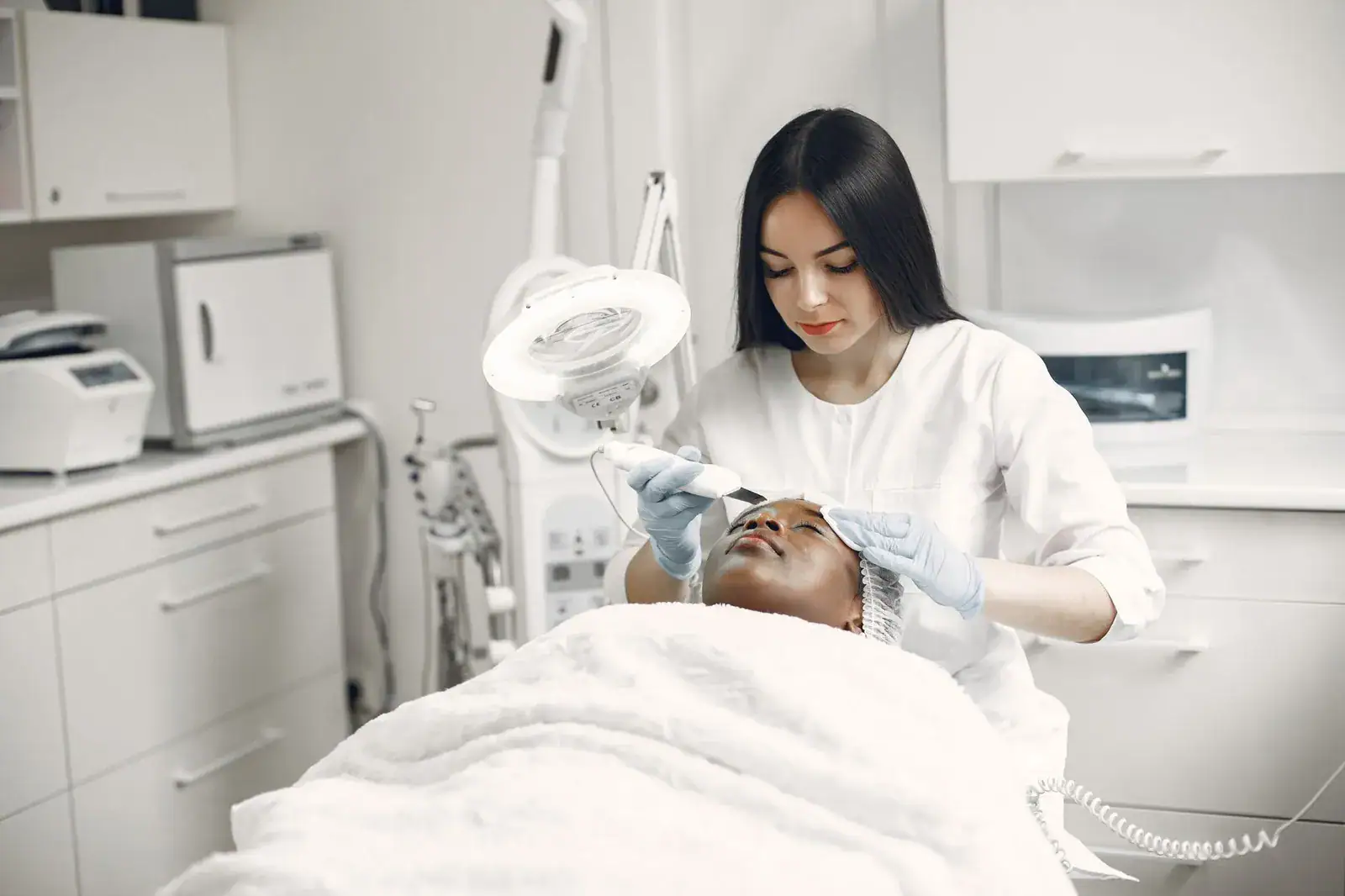
Morpheus8 sits between plain microneedling and the no-needle heat treatments. Regular microneedling reaches about 2mm with no heat and usually takes 4 to 6 sessions, against 1 to 3 for RF microneedling (Claytor Noone). Think of Morpheus8 as microneedling that went to the gym and came back with a heat lamp.
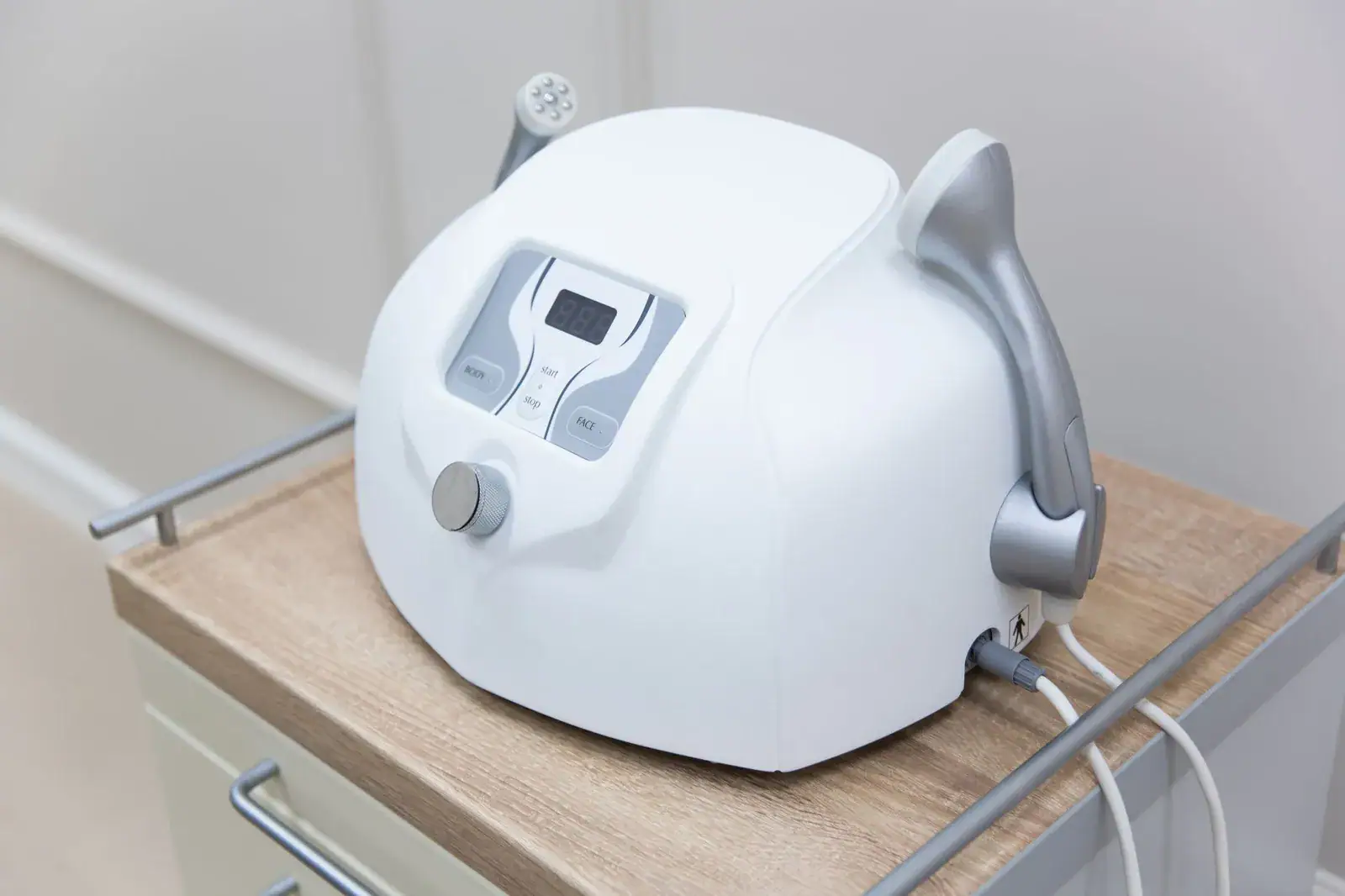
Thermage and Ultherapy use no needles at all. Thermage heats from the surface and is cleared for “non-invasive treatment of wrinkles and rhytids” (K170758). Yes, “rhytids” is a fancy word for wrinkles, and yes, I had to google it.
Ultherapy uses focused ultrasound and is cleared to “lift the eyebrow” and “lift lax submental (beneath the chin) and neck tissue” (K134032). That lifting wording is something Morpheus8’s clearance doesn’t have, a detail I find weirdly satisfying to know at parties (I am not invited to many parties).
Most people have 1 treatment, with results lasting “2 to 3 years with the right skin care.”
American Academy of Dermatology, on non-invasive RF such as Thermage (AAD)
If you’re weighing a clinic against a device, our comparison of at-home skin rejuvenation devices covers the at-home route.
Can you do Morpheus8 at home?
No. The FDA says RF microneedling devices “should not be used at home”, full stop (FDA). Anything sold online as “Morpheus8 at home” is either not RF microneedling, or it’s something you shouldn’t be pressing into your face in the bathroom. My stapler agrees, and it would know.
What does exist at home is needle-free surface RF, a different and much gentler category. In a 2022 trial, 33 women used a needle-free RF device 5 days a week for 12 weeks and beat an anti-aging cream on wrinkles and radiance, with no side effects (Dermatology and Therapy). Five days a week for twelve weeks is more commitment than I’ve given any houseplant.
That’s real but modest. It’s maintenance, not a clinic result in a box, and anyone who says otherwise is selling you a very small miracle.
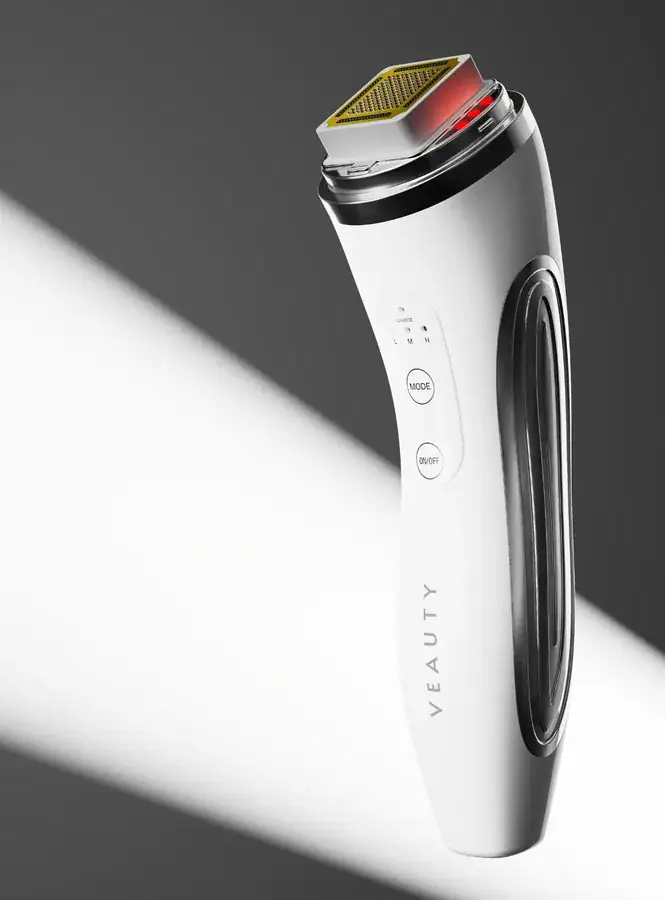
The VEAUTY Dot is one of these needle-free devices. It uses 144 electrodes that sit on the skin and never pierce it, and VEAUTY sells it as a cosmetic device, not a medical one. It is not Morpheus8 and it won’t do what a clinic needle does. It’s the “15 minutes on the sofa, a few times a week” option, for people who want steady upkeep without the stapler.
What real patients say it feels like
“For someone who considers herself with a high pain tolerance, Morpheus8 was about an eight out of ten.”
Kathy Lee, The Zoe Report
We read every first-person Morpheus8 account we could find from named writers, and the pattern is loud. The results get praise and the process gets winced at, usually in the same paragraph. (I winced reading them. From a chair. With my stapler safely in a drawer.)
Laurel Pantin said: “I noticed the biggest difference after the second treatment” in Michelle Lee’s newsletter (Michelle Lee). Alyssa Morin went the other way: “By the second round, I had to stop the treatment entirely and ask for the nitrous oxide”, and decided it “just doesn’t feel worth it to me” (Beauty Is Pain). Same treatment, opposite verdicts. It’s the skincare equivalent of two people reviewing the same rollercoaster, one grinning and one still holding the bar.
Three things came up again and again:
| What came up | The detail |
|---|---|
| Pain is real | Scores ran from 3.4 out of 10 in studies to “about an eight” in a first-person review |
| Healing takes days, not hours | Many people needed a quiet week before their skin settled |
| The second session matters | That’s when most people noticed a change |
Judging Morpheus8 after one visit is like judging a gym membership after one workout (I speak from painful, sweaty experience).
Frequently asked questions
Is Morpheus8 painful?
Yes, for most people. A 2026 review of 20 studies found average pain of 3.4 out of 10, though one first-person review rated it about 8 out of 10.
How long is Morpheus8 downtime?
Most people have redness and swelling for 1 to 3 days, then some flaking. Some patients report up to a week and a half before their skin fully settles.
How much does Morpheus8 cost?
Prices vary by clinic and area. One clinic quotes $700 to $1,500 a session, and one New York patient paid $2,900 for a single session.
Is Morpheus8 safe for dark skin?
It can be used on darker skin, but the FDA clearance limits the highest energy settings (above 62 mJ per pin) to skin types I to IV. Ask your provider which setting they plan to use.
Can Morpheus8 cause fat loss?
Yes, fat loss is a reported risk. The FDA listed it in its October 2025 safety notice, usually linked to settings that are too deep or too hot for the area.
Is Morpheus8 FDA-approved?
No, it is FDA-cleared through the 510(k) process. Its clearance covers “coagulation/contraction of soft tissue or hemostasis”, not wrinkles or fat.
Where to go from here
If you want the clinic result, book a consultation with a board-certified dermatologist and ask about depth, energy and your skin type. If you’d rather start with needle-free upkeep at home, compare your options in our guide to the best at-home skin rejuvenation devices.
The clinic route
Morpheus8 or another RF microneedling treatment
1 to 3 sessions, with a few days of recovery
A board-certified dermatologist sets depth and energy
The at-home route
A needle-free surface RF device
Short sessions a few times a week
Gentle upkeep, not a clinic result

Written by the Trusted Skincare Editorial Team
We research at-home beauty devices and skin treatments and link every claim to a published study, a regulator or a named expert. Last updated Thursday 24 September 2026.
Sources
- FDA: Potential Risks with Certain Uses of RF Microneedling (15 October 2025)
- FDA 510(k) K240017: InMode System with the Morpheus8 90 Applicator
- FDA 510(k) K170758: Thermage
- FDA 510(k) K134032: Ultherapy
- Radiofrequency Microneedling for Facial Rejuvenation: A Systematic Review (2026)
- Effectiveness of an At-Home RF Device: Randomized Split-Face Trial (2022)
- ASDS and ASLMS joint statement on RF microneedling
- American Academy of Dermatology: Firm sagging skin
- InMode UK: Morpheus8 tips
- The Zoe Report: I Tried Morpheus8 For Skin Tightening