

On this page
- Forehead wrinkle treatments compared at a glance
- What causes forehead wrinkles?
- How to get rid of forehead wrinkles at home?
- Does Botox work for forehead wrinkles?
- How do you get rid of deep forehead wrinkles?
- Do forehead wrinkle patches work?
- Can facial exercises smooth forehead lines?
- Which forehead wrinkle treatment should you try first?
- Is there a needle-free way to work on forehead lines at home?
- Your next step
Quick answer: To get rid of forehead wrinkles, match the fix to the line. Lines that only show when you raise your eyebrows respond best to Botox, which the FDA approved for forehead lines in 2017 and which lasts about 3 to 4 months. Lines that stay at rest need a nightly retinoid, daily sunscreen and, for deep ones, filler or laser.
We read 17 studies and sources on how to get rid of forehead wrinkles, from a 1988 tretinoin trial to the FDA’s 2025 warning on at-home microneedling, so every claim below links to where it came from. (I also started an Eyebrow Jar. Every time I raise my eyebrows at my phone, a quarter goes in. The jar is filling up faster than my savings account, which says a lot about my phone and more about my savings.)
Forehead wrinkle treatments compared at a glance
| Option | Best for | What the evidence shows | Worth knowing |
|---|---|---|---|
| Daily sunscreen, SPF 30+ | Everyone, every line | 903 adults: the daily group showed no detectable increase in skin aging over 4.5 years | Stops new damage. Won’t smooth old lines fast |
| Tretinoin cream (prescription) | Fine lines, sun-damaged skin | 8 trials, 1,361 people: improved fine and coarse wrinkles vs a plain cream | Irritating at first. Not for use in pregnancy |
| Retinol (over the counter) | Fine lines, a gentler start | 0.4% retinol improved fine wrinkles vs a plain lotion in 36 people over 24 weeks (tested on arms) | Weaker than tretinoin, easier to tolerate |
| Botox Cosmetic | Lines that show when you raise your brows | 61% vs 0% on placebo reached the main goal at day 30 | FDA approved for forehead lines in 2017. Brow drop in 2% |
| Filler | Deep lines that stay at rest | A clinic option for static lines. Lasts up to 6 months | 1 to 3 days of recovery |
| Laser resurfacing or peels | Deep, sun-damaged lines | Laser results last up to 5 years | 1 to 3 weeks of recovery |
| Forehead wrinkle patches | Short-term smoothing | Brand-run panels only. No independent trial found | Work like a sheet mask |
| Facial exercises | Cheeks, not the forehead | 16 women, 20 weeks: fuller cheeks. Forehead not the win | Unproven for forehead lines |
| At-home needle-free RF | Upkeep between clinic visits | 32 women, 12 weeks: forehead wrinkles improved more than with an anti-aging cream | One small trial, supported by the device maker |
Sources: Hughes 2013, Huang and Lee 2025, Kafi 2007, Botox Cosmetic label, Cleveland Clinic, CNN Underscored, ScienceDaily, Shu 2022, AAD on retinoids.
What causes forehead wrinkles?
Forehead wrinkles come from two things working together. The forehead muscle lifts your eyebrows thousands of times a year and folds the skin each time. Meanwhile, skin loses collagen with age and sun, so it stops bouncing back. Lines that show only when you move are dynamic. Lines that stay when your face is still are static.
Cleveland Clinic says you “lose about 1% of your collagen each year starting in your 30s” (Cleveland Clinic). I read that sentence with my eyebrows fully raised, which cost me a quarter and possibly another fold. Sun does the rest, breaking down the collagen and elastin that keep skin springy.
The dynamic vs static split matters more than anything else in this post, because the two need different fixes.
“Static wrinkles, on the other hand, are the lines that remain visible even when your face is completely still.”
Novuskin, a medical spa group
Try the mirror test. Relax your whole face, look straight ahead, and check whether the lines are still there. (Relaxing your face on command is weirdly hard. Mine kept doing a small, nervous smile, like it was meeting a new dentist.) Most people over 40 have a bit of both, which is why the best plans usually stack two options.
How to get rid of forehead wrinkles at home?
At home, two things have real trial evidence: a retinoid at night and broad-spectrum sunscreen every morning. Tretinoin, a prescription retinoid, improved fine and coarse wrinkles across 8 trials. Retinol is the gentler over-the-counter version. Daily sunscreen slowed visible skin aging in a 4.5-year trial. Expect months, not weeks.
Start with sunscreen, because it protects everything else. In the best trial we found, 903 Australian adults under 55 were split into daily sunscreen or use-it-when-you-feel-like-it. After 4.5 years, the daily group had 24% less skin aging (Hughes 2013). Whenever-I-feel-like-it is, by the way, exactly how I used to floss. The dentist was not impressed either.
“Regular sunscreen use retards skin aging in healthy, middle-aged men and women.”
Hughes et al., Annals of Internal Medicine, 2013
The American Academy of Dermatology goes further, saying “sun protection can also help prevent, slow down, and even reverse signs of sun damage” (AAD). That’s the most generous thing anyone has ever said about something I kept forgetting in the car.
Then add a retinoid at night. The classic trial ran 16 weeks, and “Fourteen of the 15 patients who received tretinoin to the face had improvement in photoaging, whereas none of the vehicle-treated patients’ faces improved” (Weiss 1988). A 2025 review of 8 trials and 1,361 people reached the same verdict for fine and coarse wrinkles (Huang and Lee 2025). Eight trials agreeing on anything is rarer than my group chat agreeing on a restaurant. Retinol is weaker but kinder, and 0.4% retinol still improved fine wrinkles against a plain lotion in 24 weeks (Kafi 2007). Fair warning: that trial was on the arms of people averaging 87 years old, the most patient study group in history.
If you’re choosing a strength, our guide to retinal vs retinol and which retinoid to start with walks through the ladder. Retinoids also smooth rough patches, so if your forehead feels bumpy as well as lined, our skin texture guide covers that side. [Takes off the funny hat.] The AAD says plainly that retinoids should not be used during pregnancy, so check with your doctor first if that applies to you (AAD).

Does Botox work for forehead wrinkles?
Yes. Botox Cosmetic is FDA approved for moderate to severe forehead lines, since October 2017. In the two trials behind that approval, 61% and 46% of people hit the main goal at day 30, against 0% and 1% on placebo. It relaxes the muscle that raises your eyebrows, so it works best on lines that show when you move.
The approval was Botox Cosmetic’s third facial use, after frown lines between the brows in 2002 and crow’s feet in 2013 (Allergan via BioSpace). If the lines at the corners of your eyes bother you too, our guide to crow’s feet and what smooths them covers that area. It took the FDA 15 years to get from between the eyebrows to above them. That’s roughly one inch every five years, which is also my pace on a treadmill.
Here’s what the official label says, in plain English (Botox Cosmetic label):
- The dose: 20 units spread over 5 spots on the forehead, given together with 20 units between the brows, 40 in total.
- Why both areas: the label pairs them to lower the chance of brow drop.
- How long it lasts: about 3 to 4 months for frown lines, and clinics quote the same range for the forehead.
- Side effects in the forehead trials: headache in 9% of people (5% on placebo) and a drooping brow in 2%.
That brow-drop risk is why skill matters here. The forehead muscle is the only one that lifts your eyebrows, so relaxing too much of it can leave the brows sitting lower. (Mine have one job and, judging by the jar, far too much enthusiasm for it.) A 2023 review of all the trials called these spread effects “infrequent and well tolerated” (Carruthers 2023). They were also run by trained injectors, not by me with a tutorial and a lot of confidence.
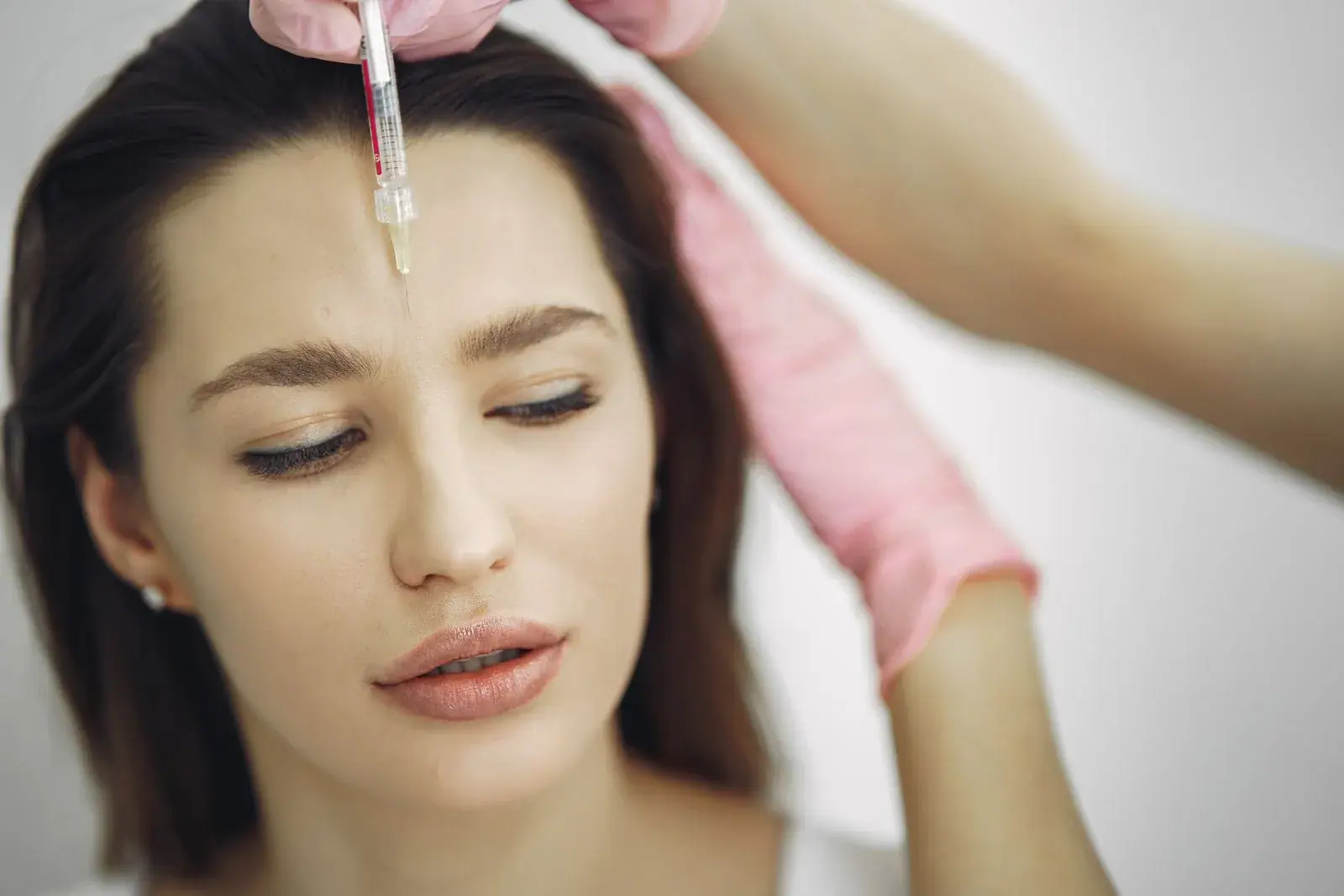
As for the Eyebrow Jar, Botox is its natural enemy. If I can’t raise my eyebrows at my phone, the jar goes hungry. (I told the jar. It took it well. It’s a jar.)
How do you get rid of deep forehead wrinkles?
Deep forehead wrinkles that stay when your face is relaxed usually need a clinic treatment on top of home care. Dermatologists use filler to lift the crease, and laser resurfacing, chemical peels or microneedling to rebuild collagen. Botox helps the moving part. Most people need a combination, and results still need upkeep.
“Wrinkles that remain at rest may require filler to fill in or lift skin with deep wrinkles.”
Cleveland Clinic
Cleveland Clinic lists the recovery like a menu (Cleveland Clinic):
- Wrinkle-relaxing injections: no recovery time.
- Microneedling and fillers: one to three days.
- Chemical peels and laser resurfacing: one to three weeks.
- How long results last: fillers, peels and injections up to six months, and laser resurfacing up to five years.
That menu is the only one I’ve read where the cheapest-looking option isn’t the one with the most downtime. Laser resurfacing lasts longest, but Cleveland Clinic notes people with darker skin have a higher risk of dark patches with some lasers, so pick a dermatologist who works with your skin tone.
RF microneedling, including Morpheus8, is another clinic route for deep lines. Our guide to what Morpheus8 is and how it compares goes through it, in more detail than anyone at a dinner party has ever asked me for. The FDA’s October 2025 notice is clear that it’s a clinic-only job:
“RF microneedling is a medical procedure, not a cosmetic treatment, and these devices should not be used at home.”
U.S. Food and Drug Administration
Do forehead wrinkle patches work?
Forehead wrinkle patches give a short-term smoothing effect, not a lasting fix. Silicone patches hold the skin flat and trap moisture while you wear them, so lines can look softer the next morning. The only numbers we found come from the brands’ own panels. We found no independent trial of forehead patches.
CNN Underscored asked four dermatologists and put it bluntly: “Wrinkle patches aren’t very effective at reversing lines” (CNN Underscored). Dermatologist Caroline Robinson, MD, said in the same piece, “I liken most wrinkle patches to sheet masks” (CNN Underscored). A sheet mask for one body part. I respect the commitment.
There’s a small case for them as prevention, though nobody has measured it.
“By limiting repetitive creasing during sleep, they may help slow wrinkle deepening over time.”
Jenna Queller, MD, in CNN Underscored
Note the “may”. That’s practitioner opinion, not a trial result, so treat patches as a cheap nice-to-have. (Also, they’re a little hard to explain when someone knocks on the door at 7 a.m. Ask me how I know. Actually, don’t.)
Can facial exercises smooth forehead lines?
There’s no good evidence that facial exercises smooth forehead lines. The only controlled study, from Northwestern in 2018, had 16 women do 30 minutes of face exercises a day for 20 weeks, and the clear gain was fuller cheeks. Raising your eyebrows over and over is also the exact movement that creases the forehead.
The study recruited 27 women and 16 finished, doing 32 different exercises, daily for 8 weeks and then every other day (ScienceDaily). The raters found that “upper cheek and lower cheek fullness, in particular, was significantly enhanced” (ScienceDaily). Good news for cheeks. Nothing to celebrate for foreheads.
Some brand guides still suggest “raising and relaxing your eyebrows” as a forehead exercise (Caudalie). I tried it for one evening. The Eyebrow Jar made more money in 20 minutes than it had all week, and my forehead looked exactly the same. Exercises that work the forehead muscle probably deepen dynamic lines rather than soften them. That’s reasoning from how the muscle works, not a tested result.
Which forehead wrinkle treatment should you try first?
Start with daily sunscreen and a retinoid at night, because they’re cheap, well studied and help every type of line. Give the retinoid about four months. If lines still show when you raise your eyebrows, Botox is the best-proven next step. For deep lines at rest, see a board-certified dermatologist about filler or resurfacing.
Most people skip straight to step 3, the same way I skip straight to the last page of a mystery. It’s faster. It’s also why I never know who did it. Steps 1 and 2 keep working long after an injection wears off, so they’re worth starting even if you book Botox too.
The Eyebrow Jar has a new job, by the way. It now has a label that says SUNSCREEN FUND, and every quarter goes toward the next bottle. Easily the most useful thing my eyebrows have ever done.
Is there a needle-free way to work on forehead lines at home?
Yes. At-home radiofrequency devices sit on the skin and warm it without needles. In one 12-week split-face trial of 32 women aged 35 to 60, the device side improved more in forehead wrinkles than the side using an anti-aging cream. It’s one small trial, supported by the device maker, so think upkeep, not a clinic result.
At week 12, the researchers reported that “the experimental side had significantly greater improvement in forehead wrinkles” than the cream side, along with crow’s feet, smile lines and pores (Shu 2022). Two catches: sessions were five days a week for two months, supervised at a research center, and the maker supplied the device. I can’t keep a houseplant alive five days a week, so be honest with yourself about the schedule.
If you want that route, the VEAUTY Dot is a needle-free option: 144 electrodes that sit on the surface and never pierce the skin. It’s a cosmetic device, and it’s rated 4.8 out of 5 from 1,163 reviews on its own store. It wasn’t the device tested in that trial, and for forehead lines, Botox has much stronger evidence. Think of it as the 15 minutes on the sofa that go with sunscreen and a retinoid. Our comparison of at-home skin rejuvenation devices puts it side by side with the alternatives.
Frequently asked questions
Can you get rid of forehead wrinkles naturally?
Not completely. The best-studied home steps are daily broad-spectrum sunscreen and a retinoid at night. Facial exercises and patches have little or no evidence for forehead lines.
How many units of Botox are used for forehead lines?
The Botox Cosmetic label gives 20 units across 5 forehead spots, together with 20 units between the brows, for 40 units in total. Your injector adjusts the plan to your face.
How long does Botox last on the forehead?
About 3 to 4 months for most people. Repeat treatments are usually needed to keep the result.
Are forehead wrinkles permanent?
Lines that only show when you move can soften a lot with Botox. Lines that stay at rest improve with retinoids and clinic treatments, but they rarely disappear completely.
At what age do forehead wrinkles start?
Cleveland Clinic says most people start to see signs of skin aging after 25. Fine lines come first and deepen as skin loses collagen.
Is Botox or retinol better for forehead wrinkles?
They do different jobs. Botox relaxes the muscle behind moving lines. Retinoids improve fine lines and skin quality over months. Many people use both.
Your next step
Do the mirror test tonight to see whether your lines are dynamic, static or both. Then start daily sunscreen and a retinoid, and give them about four months. If moving lines still bother you after that, book a board-certified dermatologist to talk about Botox.

Written by the Trusted Skincare Editorial Team
We research at-home beauty devices and skin treatments and link every claim to a published study, a regulator or a named expert. Last updated Sunday 27 September 2026.
Sources
- Hughes et al. 2013, sunscreen and prevention of skin aging (Annals of Internal Medicine)
- Weiss et al. 1988, topical tretinoin improves photoaged skin (JAMA)
- Huang and Lee 2025, tretinoin for photodamaged facial skin, meta-analysis
- Kafi et al. 2007, retinol and naturally aged skin (Archives of Dermatology)
- Botox Cosmetic prescribing information (AbbVie)
- Allergan: FDA approves Botox Cosmetic for forehead lines, 2017
- Carruthers et al. 2023, Botox for crow’s feet and forehead lines review (Medicine)
- Cleveland Clinic: Treatments to reduce wrinkles
- American Academy of Dermatology: How to treat sun-damaged skin
- CNN Underscored: Do wrinkle patches actually work?
- Shu et al. 2022, at-home radiofrequency split-face trial (Dermatology and Therapy)
- FDA: Potential risks of certain uses of RF microneedling, October 2025