
On this page
- What works on red stretch marks, and what doesn’t
- Why are my stretch marks red?
- Red vs purple stretch marks: what’s the difference?
- Do red stretch marks go away?
- How to get rid of red stretch marks
- Red stretch marks on your stomach and thighs
- Where at-home radiofrequency fits
- When to see a doctor about red stretch marks
- Your next step
Quick answer: Red stretch marks are new stretch marks, called striae rubra. They look red because small tears in the deeper skin let the blood vessels underneath show through. Most fade to silvery-white over 6 to 12 months. Red is the best time to treat them, because prescription tretinoin, pulsed dye laser and clinic radiofrequency all work better on red marks than on white ones.
We read 42 studies and reviews, from a 1996 tretinoin trial to a 2026 review across skin types, so every claim below links to where it came from. (Forty-two. I needed a lie down after nine.)
What works on red stretch marks, and what doesn’t
| Treatment | What the evidence shows | Best for | Worth knowing |
|---|---|---|---|
| Prescription tretinoin 0.1% | 80% improved vs 8% on a dummy cream after 6 months (22 people) | New red marks | Not in pregnancy. Weaker 0.025% did nothing |
| Pulsed dye laser | Less redness in red marks, no change in white ones (20 people) | Taking the red out | Extra caution on darker skin (types V to VI) |
| Clinic radiofrequency | Ranked second of all treatments across 14 trials and 651 people | Depth and texture | Clinic machines only in these studies |
| Microneedling | Every mark improved by at least half after about 2 sessions (25 adults, skin types I to V) | All skin tones | A small case series |
| Hyaluronic acid or centella creams | Small studies, some help on early marks | Early marks, gentle routines | Modest at best |
| Cocoa butter or olive oil | No real effect: 44% vs 55% got marks in a 300-woman trial | Nothing, sadly | Nice smell, no proof |
Sources: Kang 1996, Pribanich 1994, Jiménez 2003, Lu 2020 meta-analysis, Alster and Li 2020, Ud-Din 2016 review, AAD, Buchanan 2010.
Why are my stretch marks red?
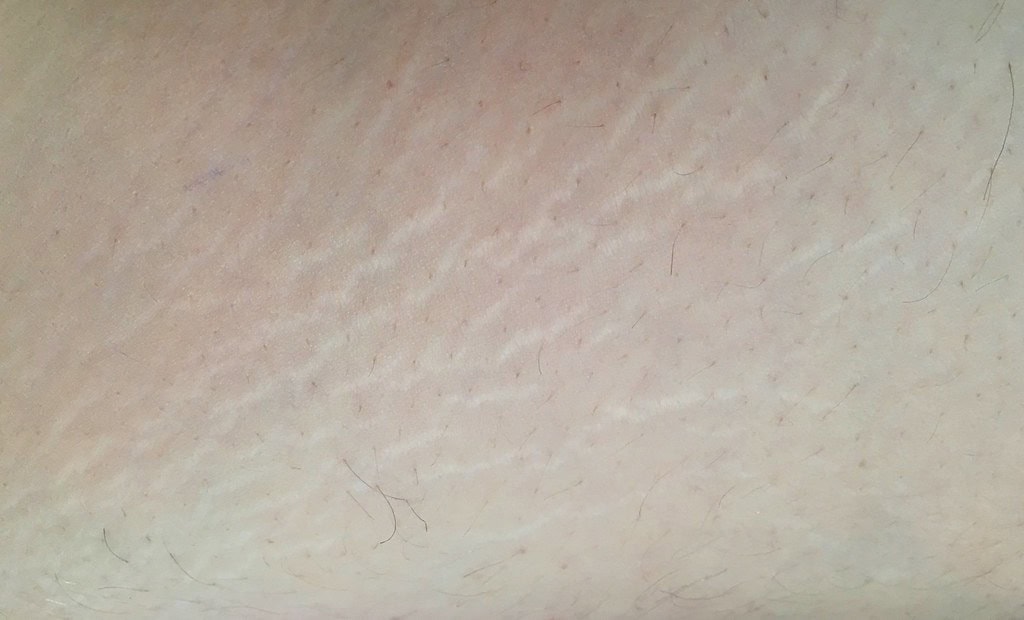
Stretch marks are red at first because the skin’s middle layer has torn, and the blood vessels below show through the gap. The Northern Ireland health service puts it more plainly than I ever have, and I’ve tried at three dinner parties.
“The tears in the dermis allow the blood vessels below to show through, which is why stretch marks are often red or purple when they first appear.”
nidirect, the Northern Ireland government health site
Think of it as your skin’s teacher going over your homework in red pen. Harsh, but temporary. [Hands in homework. Braces for impact.]

A 2019 study of 61 women found stretch marks were no drier than normal skin, just less elastic (Cho 2019). So “just moisturize more” was never going to fix it. I say this as someone who owns a shelf of body butters bought purely because the woman on the tub looked very, very calm.
Red vs purple stretch marks: what’s the difference?
Red and purple stretch marks are the same early stage, and the color mostly depends on your skin tone. The American Academy of Dermatology says early marks can be “red, purple, pink, reddish-brown, or dark brown, depending on your skin color” (AAD). So “red” in this article just means “new”, whatever shade your red pen came in. (Yes, the red pen is back. It’s staying. Get comfortable.)
Wide purple marks with other symptoms are the exception. The US National Institute of Diabetes and Digestive and Kidney Diseases lists “wide purple stretch marks, mainly on the abdomen, breasts, hips, and under the arms” as a sign of Cushing’s syndrome, together with weight gain, a round face, thin arms and legs and easy bruising (NIDDK). I once diagnosed myself with three rare conditions in one evening of scrolling, so trust me: it’s the combination that matters, not one purple line.
It’s rare, about 40 to 70 people per million, and the most common cause is long-term steroid medicine. If that combination sounds like you, see a doctor before you see a skincare aisle.
Do red stretch marks go away?
Red stretch marks usually fade, but they rarely vanish. Cleveland Clinic says “stretch marks take between six and 12 months to fade” (Cleveland Clinic), and WebMD says that “after 1 year, stretch marks are considered mature” (WebMD). A year is about how long my gym membership lasted, with similar results.
Nobody has actually measured how long the red lasts, so treat those numbers as a doctor’s rule of thumb. (I looked. Hard. I have the open tabs to prove it.) The red pen eventually runs out of ink, and what’s left is a silvery line.
That’s why timing matters so much. The American Society for Dermatologic Surgery says marks treated “when they are still purple or red – more readily respond to treatment” (ASDS), and a 2026 review across skin types agreed that red marks “generally responded more favorably” than white ones (Chaudhury 2026). In other words, the red phase isn’t the bad news. It’s the deadline, and unlike me with every deadline ever, you still have time.
How to get rid of red stretch marks
You can fade red stretch marks, but no treatment fully erases them. A 2017 review of 74 papers concluded that “no treatment has proved to be completely effective” (Hague and Bayat). Anyone selling “gone in 7 days” is selling you a very optimistic jar, and I would know, because I bought that jar. Twice.
Prescription tretinoin is the best-studied cream. In the key trial, 0.1% tretinoin for 6 months improved 8 of 10 people with early marks, against 1 of 12 on a dummy cream (Kang 1996). Eight out of ten is a better survival rate than my entire houseplant collection.
Strength matters: 0.025% did nothing at all (Pribanich 1994). Same ingredient, weaker dose, zero results, which is also my whole experience with decaf. Retinoid creams “should not be used in pregnancy”, says the UK Teratology Information Service (UKTIS), so park this one until after the baby.
“Topical application of tretinoin significantly improves the clinical appearance of early, active stretch marks.”
Kang and colleagues, Archives of Dermatology, 1996
Clinic treatments do the heavy lifting. Pulsed dye laser targets the blood vessels, which is why it helps red marks and not white ones (Jiménez 2003). It’s basically a laser that only cares about the red pen.
Clinic radiofrequency ranked second of every treatment in a 2020 analysis of 14 trials (Lu 2020), and in one trial it cut mark depth by 21.64% at 6 months while untreated skin got 1.73% deeper (Harmelin 2016). Clinic machines sadly don’t come in travel size, and believe me, I’ve checked. [Closes fourteen tabs.]
Red stretch marks on your stomach and thighs
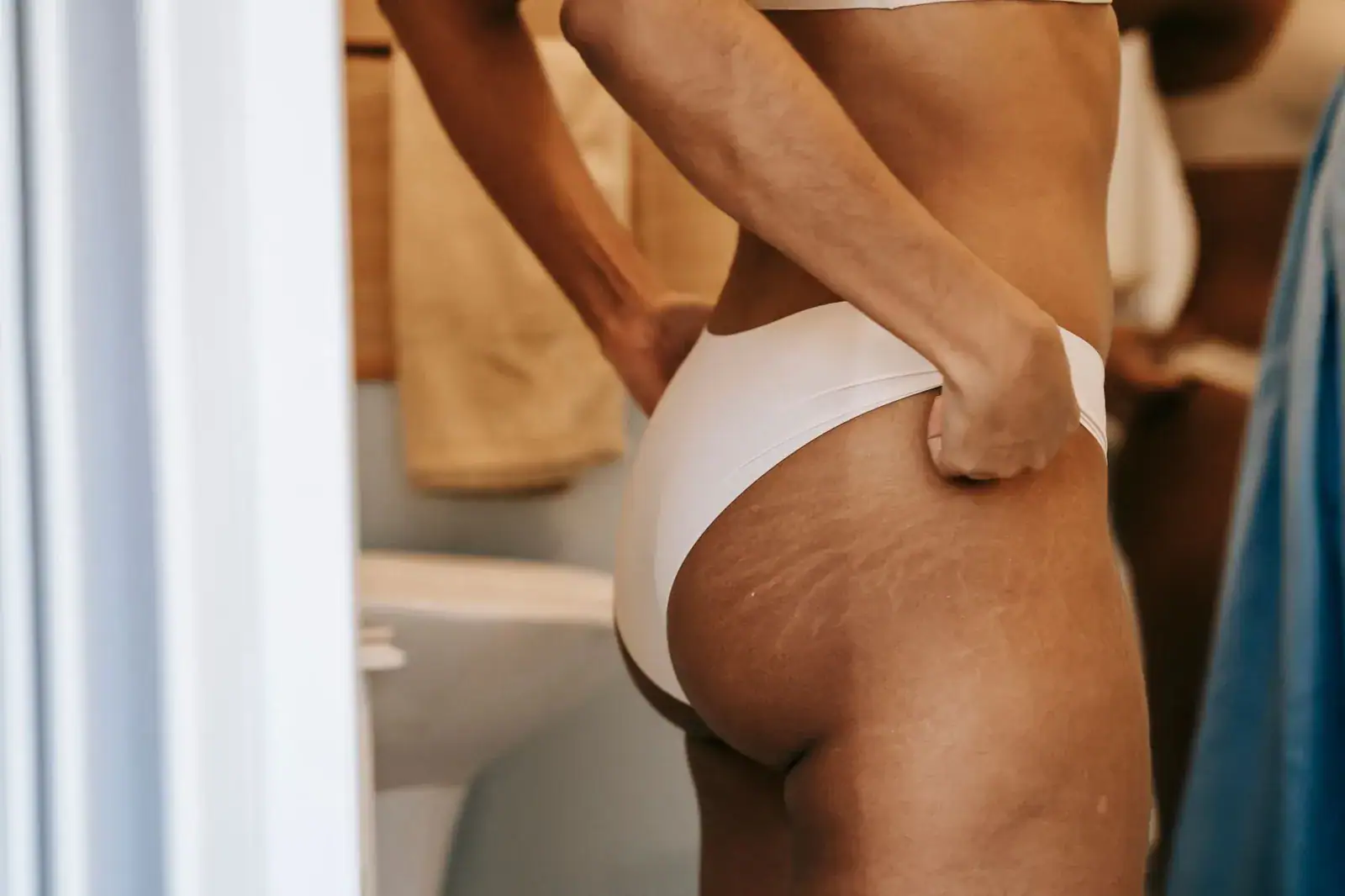
The stomach and thighs are where red stretch marks show up most, because that’s where skin stretches fastest. Pregnancy is the big one for the stomach: stretch marks affect 50% to 90% of pregnant women, according to the Cochrane review (Cochrane). If you’re reading this with a bump, congratulations, and no, the red pen isn’t grading you. It’s grading the stretch, and the stretch was for a very good reason.

Thighs belong to growth spurts, weight changes and the gym. In a study of 157 Korean students aged 15 to 17, 83.4% had stretch marks, and boys had them more often than girls, 88.2% against 77.1% (Cho 2006). Teenage boys: out-stretching everyone since at least 2006.
So the “only women get them” idea is wrong, and so is the “only if you’re overweight” idea. One lifter on a forum admitted: “I got scared ‘cuz I was told only fat people had it, so I thought it meant I would be fat” (AnandTech forums). Relatable, and wrong on both counts, which is also how I’d describe most of my twenties.
Where at-home radiofrequency fits
Here’s the honest version: every radiofrequency study on stretch marks used clinic machines, and we found no published trial of an at-home RF device on stretch marks. (Awkward, for a site that loves a gadget. We’re saying it anyway.) New York dermatologist Jessica Weiser, MD, goes further, saying “at-home microneedling or rollers, and LED therapy generally don’t create any notable improvement” (WebMD). We’d rather tell you that now than have you find out six weeks and one credit card statement later.
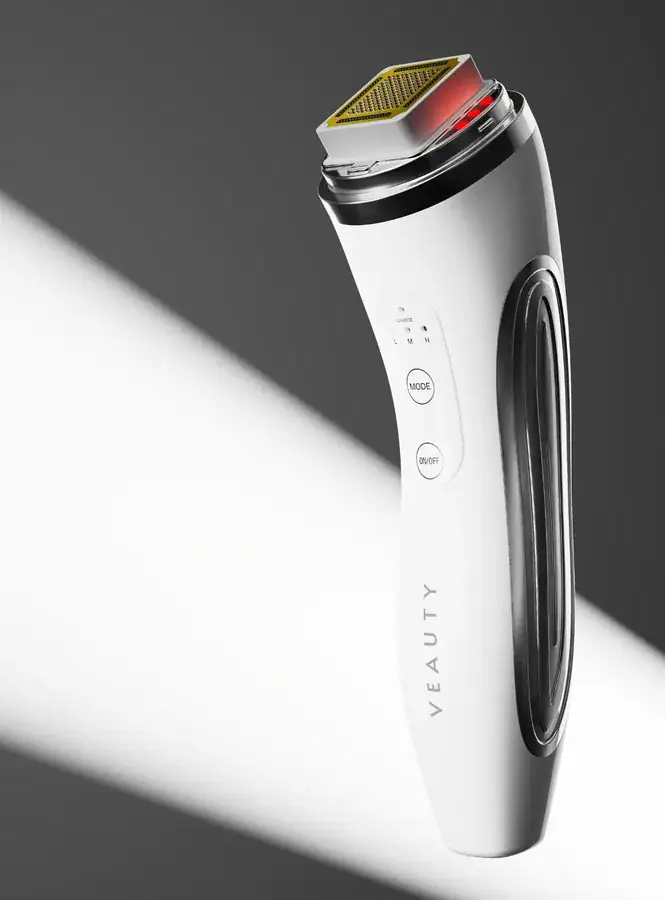
The VEAUTY Dot is a needle-free, at-home RF device. Its 144 electrodes sit on the skin and never pierce it. VEAUTY says it “helps fade superficial stretch marks over time”, and it carries a 4.8 out of 5 rating from 1,163 reviews on its own store. Two of those reviews mention stretch marks.
“I was placed on corticosteroids and my stretch marks came, they crippled my confidence. I was told to try RF on them so bought your device and have been using it consistently and the results are fabulous, I can finally show my shoulders again.”
Jen S, 29, review on veautystore.com
Mikayla W, 36, wrote: “After my pregnancy I got really bad stretch marks, I was looking into radio frequency treatments and found the VEAUTY Dot, I’m so happy I did, the results are so good.”
Those are customer reviews, not a clinical trial, and results vary. I’d love to hand you a study here, but I’d have to make one up, and I was raised better than that.
If you want the strongest evidence, a dermatologist with a clinic RF machine or a pulsed dye laser is it. If you want something gentle to use at home, 15 minutes at a time, while the marks are still red, that’s the gap a device like this aims at. Either way, act while the red pen is still out.
When to see a doctor about red stretch marks
See a doctor if your stretch marks are wide and purple and come with other changes, such as weight gain around the middle, a round red face, thin arms and legs or easy bruising. This is the one part of the article where I put the red pen down.
The NHS lists these as reasons to see a GP (NHS). Also see one if marks appear suddenly while you’re on steroid medicine. Your search history, sadly, does not count as a second opinion.
“Wide purple stretch marks, mainly on the abdomen, breasts, hips, and under the arms.”
A warning sign of Cushing’s syndrome, per the US National Institute of Diabetes and Digestive and Kidney Diseases
For everyday red stretch marks, a dermatologist is the person who can tell you which treatment suits your skin tone.
Frequently asked questions
Are red stretch marks new?
Yes. Red or purple stretch marks are the early stage, called striae rubra. Over months they usually fade to a silvery-white color.
How long do stretch marks stay red?
Usually 6 to 12 months. After about a year, doctors consider them mature. No study has measured this exactly, so it varies from person to person.
Are red stretch marks easier to treat than white ones?
Yes. Studies and the American Society for Dermatologic Surgery agree that red marks respond better to treatment than white marks.
Can I treat red stretch marks while pregnant?
Avoid tretinoin and other retinoid creams during pregnancy. Ask your doctor or midwife before starting any treatment, and laser or clinic treatments can wait until after the baby.
Does cocoa butter help red stretch marks?
No. Two randomized trials found cocoa butter did not prevent stretch marks, and a Cochrane review found no high-quality evidence for any cream.
Are purple stretch marks dangerous?
Usually not. Wide purple stretch marks together with weight gain, a round face and thin arms and legs can be a sign of Cushing’s syndrome, which needs a doctor.
Your next step
Red means you’re early, and early is when treatment works best. For the clinic route, book a dermatologist while the marks are still red. For the at-home route, see how the options compare in our guide to the best at-home skin rejuvenation devices.
The clinic route
Prescription tretinoin, pulsed dye laser or clinic RF
The strongest evidence, best while marks are red
A dermatologist matches it to your skin tone
The at-home route
A needle-free surface RF device
No published trial on stretch marks yet
Gentle and low effort while marks are still red

Written by the Trusted Skincare Editorial Team
We research at-home beauty devices and skin treatments and link every claim to a published study, a regulator or a named expert. Last updated Thursday 24 September 2026.
Sources
- Kang et al. 1996, topical tretinoin on early stretch marks
- Jiménez et al. 2003, pulsed dye laser on red and white stretch marks
- Lu et al. 2020, network meta-analysis of 14 trials
- Harmelin et al. 2016, fractional radiofrequency on stretch marks
- Brennan et al. 2012, Cochrane review of creams in pregnancy
- Chaudhury et al. 2026, stretch mark treatments across skin types
- American Academy of Dermatology: Stretch marks
- NIDDK: Cushing’s syndrome
- nidirect: Stretch marks
- VEAUTY Dot product page and reviews