

On this page
- Hollow under eyes vs dark circles vs bags at a glance
- What are hollow under eyes?
- What causes sunken eyes?
- Is it a hollow, a dark circle or a bag?
- Can eye cream fix hollow under eyes?
- How does tear trough filler work?
- How long does tear trough filler last, and what does it cost?
- Is tear trough filler safe?
- When should you see a doctor about sunken eyes?
- Can an at-home device fix hollow under eyes?
- Your next step
Quick answer: Hollow under eyes, also called tear troughs or sunken eyes, are grooves between the lower eyelid and the cheek. They mostly come from fat and bone loss with age, plus genetics and weight loss. Creams and sleep cannot add that volume back. Tear trough filler from a trained injector is the standard fix and lasts about one to two years.
We read 21 studies and sources on hollow under eyes, from a 2009 cadaver study of the tear trough to the FDA’s 2022 approval of a filler for under-eye hollows, so every claim below links to where it came from. (I also bought a whole cucumber for this article, purely for research. I used two slices. The rest of it is still in my fridge, and every time I open the door it looks at me like I owe it an explanation.)
Hollow under eyes vs dark circles vs bags at a glance
| Hollow (tear trough) | Dark circles | Under-eye bags | |
|---|---|---|---|
| What it is | A sunken groove between the lower lid and the cheek | A color change: brown, blue or purple skin | A soft bulge under the lower lid |
| Main cause | Fat and bone loss with age, genetics, fast weight loss | Pigment, thin skin showing blood vessels, or the shadow of a hollow | Fat behind the lid pushing forward, plus fluid |
| Can a cream help? | No. Creams cannot add volume | Partly: sunscreen, vitamin C, caffeine, concealer | Caffeine may calm puffiness. It cannot move fat |
| Standard fix | Tear trough or cheek filler from a trained injector | Skin care, sun protection, makeup | Lower eyelid surgery when fat is the cause |
Sources: WebMD, Cleveland Clinic, Haddock et al. 2009, Hamie et al. 2024 eye cream review, The Skin Center.
What are hollow under eyes?
Hollow under eyes are a sunken groove running from the inner corner of the eye down along the top of the cheek. Doctors call it the tear trough, or a tear trough deformity when it is deep. The groove casts a shadow, so it often looks like a dark circle even when the skin color is normal.
“Under eye hollows is a condition also known as sunken eye hollows or tear trough deformity.”
WebMD, medically reviewed by Debra Jaliman, MD
Flowers named it the tear trough back in 1969 (Hirmand 2010), and a 2014 study put the problem plainly: “The shadow created by this groove is commonly perceived as dark circles” (Wollina 2014). Hollow eyes, sunken eyes, tear trough: one groove, more aliases than my saved passwords.
What causes sunken eyes?
Sunken eyes mostly come from aging: the fat pads under the eyes shrink and the bones around the eye socket thin and widen, so the groove deepens. Genetics, fast weight loss, dehydration, poor sleep, allergies and sinus problems can make it look worse. When both sides hollow slowly over years, age is the most likely cause.
“As we age, the bones in our face thin and widen, so we lose some of the fat, or padding, around our eyes.”
Cleveland Clinic, with dermatologist Shilpi Khetarpal, MD
A 2009 study dissected 12 lower lids and concluded that “Atrophy of skin and fat is the most likely explanation for age-related visibility of these landmarks” (Haddock et al. 2009). The area is fixed to bone, so it doesn’t slide down with age. It thins. Nothing is falling, things are just packing lighter, which is more than I can say for my carry-on.
Other things that deepen the look:
- Genetics: some families have a visible groove from a young age (WebMD).
- Fast weight loss: fat leaves the face too.
- Dehydration and poor sleep: both can make eyes look more sunken, and dehydration is more serious in children.
- Allergies and sinus problems: sinus inflammation “can make your eyes appear dark and sunken” (Healthline).
WebMD adds: “When both of your under eyes are hollowed, the cause is most likely age-related” (WebMD). I tried fixing mine with a heroic week of drinking water. I now know every restroom within a mile of my house, and the groove is exactly where I left it.
Is it a hollow, a dark circle or a bag?
Check it in two kinds of light. A hollow is a shadow, so it shifts when you move from facing a window to standing under a ceiling light. A dark circle is a color, so it stays about the same in any light. A bag is a soft bulge just above the groove. Many people have two at once.
That light check is practitioner consensus, not a validated test, though a 2024 expert panel lists lighting as a key assessment step (Liew et al. 2024). I did it at my bathroom window with the focus of a cat tracking a laser pointer. Window, ceiling, window, ceiling.
A 2024 review of eye cream ingredients says “Hypervascularity, aging, and tear trough depression are all causes of dark undereye circles” (Hamie et al. 2024). So a dark circle can be pigment, visible blood vessels, or a hollow in a dark circle costume. I can’t tell my navy socks from my black ones, so I respect anyone who sorts this out first try.
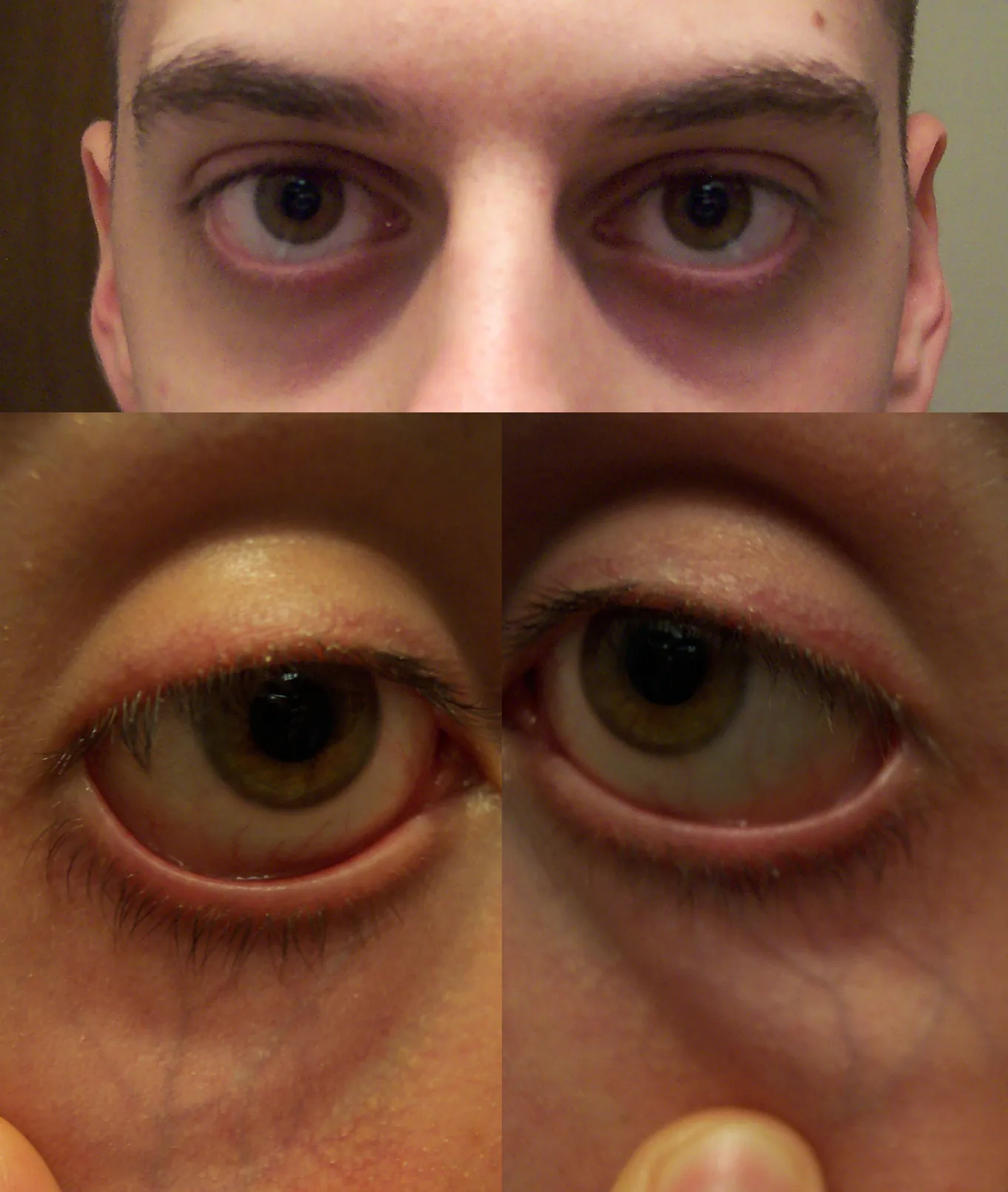
Bags make hollows look deeper. The 2009 dissection study found that “Bulging orbital fat accentuates these landmarks” (Haddock et al. 2009), meaning a puffy ledge above the groove throws a darker shadow below it. That’s why a hollow sitting under a big bag is often a job for an eyelid surgeon rather than filler alone (The Skin Center). Some of it was the bag all along. The bag knows what it did.
Can eye cream fix hollow under eyes?
No. Eye cream cannot replace lost fat or bone, so it cannot fill a hollow. It can help the skin around it: caffeine may calm puffiness, a gentle retinoid can smooth crepey skin and fine lines over months, and daily sunscreen protects thin skin. Better skin can soften the shadow a little, but the groove stays put.
The evidence for eye creams is thinner than the skin they go on. The 2024 review says “There is a lack of clinical trials particularly reviewing the efficacy of retinoids contained within an eye cream formulation and used on periorbital skin” (Hamie et al. 2024). Translation: the tiny jar with the big promises was mostly tested next door. The same review says caffeine helps with fluid retention, and a 3% caffeine pad reduced under-eye pigmentation in 11 women. Useful for bags and color. Useless for volume, which brings me, reluctantly, to the cucumber.
Cold can calm swelling for a while, which is why Cleveland Clinic suggests a cold compress after filler (Cleveland Clinic). So I lay on the couch for twenty minutes with two cucumber slices on my face. I got up, and the groove was still there, just slightly damp and smelling faintly of salad.
If you want a retinoid near the eyes, go gentle. The review notes “mild complaints of erythema, peeling, and dryness have been reported” with retinoids (Hamie et al. 2024), and our retinal vs retinol comparison explains which is milder. If it stings, stop and repair your skin barrier first. Crinkly lines are their own topic: see fine lines and what softens them.
How does tear trough filler work?
A trained injector places small amounts of soft hyaluronic acid gel, with a fine needle or a blunt cannula, into the groove or the upper cheek to lift the shadow. Cleveland Clinic says the procedure takes about 5 to 10 minutes. Two fillers, Juvederm Volbella XC and Restylane Eyelight, are FDA-approved for under-eye hollows in adults over 21.
“Nonsurgical correction of the tear trough deformity with hyaluronic acid is effective and safe and is associated with high patient satisfaction.”
Haideh Hirmand, MD, Plastic and Reconstructive Surgery, 2010
Volbella XC was approved in February 2022: in the maker’s trial, 83.1% of treated people improved versus 15.6% of an untreated group, and 90% were satisfied a year later (AbbVie). Restylane Eyelight followed in June 2023: in its trial, 87% of patients had less under-eye hollowness at 3 months and 84% were still pleased at one year (Galderma). Both are companies reporting their own trials, so read them as a strong start, not the last word. For Volbella XC, the FDA also required injector training on eye anatomy and complications. I needed less training to get a library card, and I still return books late.
Dr. Khetarpal told Cleveland Clinic that “Some fillers can be very firm and stiff like Jell-O, others are going to be very water-like and thin” (Cleveland Clinic). Under the eyes, softer is the goal. I say this as someone who has eaten Jell-O standing up at the fridge, right next to the cucumber, which watched.
Some injectors start in the cheek instead, because lost cheek support deepens the groove (The Skin Center). It’s the same hyaluronic acid used for marionette lines, placed with a lot more caution. [Puts the Jell-O down.]
| Option | What it does for a hollow | How long it lasts | Worth knowing |
|---|---|---|---|
| Tear trough filler (hyaluronic acid) | Fills the groove directly | About 1 to 2 years | Can be dissolved. Highest-risk injection zone |
| Cheek filler | Lifts the shadow from below | Varies by product | May be enough on its own for some people |
| Fat transfer or fat repositioning | Moves your own fat into the groove | Varies | More invasive than filler |
| Lower eyelid surgery | Moves or removes bulging fat and skin | Long-term | Best when bags are the main problem |
| Eye cream | Helps skin quality and puffiness | While you use it | Adds no volume |
Sources: Cleveland Clinic, The Skin Center, Hamie et al. 2024.
How long does tear trough filler last, and what does it cost?
Most people need a top-up every one to two years, according to Cleveland Clinic. In one study of 40 women, hyaluronic acid in the tear trough lasted 10.1 months on average. The American Society of Plastic Surgeons puts the average fee for a hyaluronic acid filler at $715, and some people need a second visit.
The full effect shows after about two weeks (Cleveland Clinic), and in the 40-woman study 95% of patients were satisfied (Wollina 2014). The $715 is a national average from the American Society of Plastic Surgeons, and price climbs with experience and zip code. (I compared prices in three browser tabs, then a fourth, then closed them all and made toast.)
In a study of 202 eyes, 18% of patients needed more filler within three months, and side effects included bruising in 10% and the Tyndall effect in 1%, which the authors describe as “the bluish hue visible within the skin caused by too superficial placement of HA filler” (Hall et al. 2018). Placement depth matters a lot under thin skin. The cucumber, for the record, did not last a year. It did not last the week.
Is tear trough filler safe?
It is generally safe in trained hands, but the area around the eyes is one of the riskiest places on the face to inject. The FDA warns that filler entering a blood vessel can block blood flow, and reported complications include tissue death, blindness and stroke. They are rare, but they can be permanent.
“The most concerning risk associated with the use of dermal fillers is unintentional injection into a blood vessel, leading to blocked blood vessels and poor blood supply to tissues.”
US Food and Drug Administration
The FDA says “Complications reported include necrosis (death of tissue), vision abnormalities including blindness, and stroke”. Its filler page also lists injecting the “periorbital area (around the eyes)” among uses it has not approved for fillers in general, so anything other than the two products approved for under-eye hollows is used off-label there (FDA). A review of FDA reports from 1980 to 2020 found 85 patients with eye injuries after facial filler, 75.4% of them after hyaluronic acid (ASDS). The American Society for Dermatologic Surgery explains the mechanism: “When the blood is prevented from reaching the eye, vision loss and even blindness can result” (ASDS).
Know the warning signs. Cleveland Clinic says “Extreme pain, loss of vision or seeing floaters at the time of your injection are signs that something could be wrong” (Cleveland Clinic). Hyaluronic acid filler can be dissolved with an enzyme injection, so the provider should have a plan for this before they start. Seek emergency care right away for any change in vision after filler.
How to lower the risk:
- Choose the injector carefully: Cleveland Clinic recommends a licensed dermatologist, plastic surgeon or oculoplastic surgeon over a med spa, and suggests you “make sure you know your provider, know their credentials and see pictures of their past work” (Cleveland Clinic).
- Never buy filler to inject yourself: “The FDA has also not approved any dermal fillers for over-the-counter (OTC) use”, and it says needle-free filler pens are not approved either (FDA).
- Ask what product they use and whether it is approved for this area.
When should you see a doctor about sunken eyes?
See a doctor if only one eye looks sunken, if the change came on quickly, if it followed an injury, or if it comes with vision changes, pain, congestion, unexplained weight loss or feeling unwell. A sunken eye can point to a sinus problem, a fracture around the eye or a side effect of some glaucoma eye drops.
- One eye only: Cleveland Clinic explains that a sunken eye, called enophthalmos, “can happen in one eye (unilateral) or both eyes (bilateral)”. Causes include eye socket fractures and silent sinus syndrome (Cleveland Clinic).
- Glaucoma eye drops: prostaglandin drops can thin the fat around the eye. In a small study, the changes partly improved a year after the drops were stopped (Abalo-Lojo et al. 2023). Never stop glaucoma drops on your own. Ask your eye doctor.
- A child with sunken eyes: Healthline says “If your child has sunken eyes, along with diarrhea and vomiting, see a doctor”, because it can be a sign of serious dehydration (Healthline).
Can an at-home device fix hollow under eyes?
No. A hollow is missing volume, and no cream or at-home device puts volume back. Needle-free radiofrequency devices aim at skin quality instead. In a 2022 split-face trial, 32 women aged 35 to 60 finished 12 weeks of using one at home, and the device side improved more than the cream side on wrinkles, radiance and skin thickness.
That trial is small and looked at overall facial aging, not hollows (Shu et al. 2022). Real but modest, which is still more evidence than my cucumber ever produced. The VEAUTY Dot is one of these needle-free devices. Its 144 electrodes sit on the surface of the skin and never pierce it, and it is sold as a cosmetic device, rated 4.8 out of 5 from 1,163 reviews on its own store. Those are customer reviews, not a clinical trial, and results vary. It has not been tested on under-eye hollows, so think of it as skin-quality upkeep for the rest of the face, such as the cheeks and jawline. For the hollow itself, tear trough filler from a trained injector is the standard fix, and lines at the eye corners have their own guide on crow’s feet.
Frequently asked questions
Do hollow under eyes go away on their own?
Hollows caused by dehydration, poor sleep, illness or allergies can improve once the cause is fixed. Hollows from age-related fat and bone loss do not go away on their own. They need a treatment that adds volume, such as filler.
Can you get hollow eyes in your 20s?
Yes. Genetics shape the eye area, so some people have a visible tear trough from a young age. Fast weight loss can also cause hollows at any age.
How long does tear trough filler last?
Usually one to two years, according to Cleveland Clinic. One study of 40 women found hyaluronic acid in the tear trough lasted 10.1 months on average.
Can tear trough filler be reversed?
Yes. Hyaluronic acid filler can be dissolved with an enzyme injection called hyaluronidase. This is also the emergency treatment if filler blocks a blood vessel.
Does tear trough filler hurt?
Discomfort is usually low. Cleveland Clinic says the provider cleans and ices the area first, and a study of 24 patients treated with a blunt cannula reported a very low pain rating.
Your next step
Check your under-eyes in two kinds of light to see whether you are looking at a hollow, a dark circle or a bag. If only one side has changed, or it changed fast, see a doctor first. If it is a true hollow, book a consultation with a board-certified dermatologist, plastic surgeon or oculoplastic surgeon and ask what they would put where, and why.

Written by the Trusted Skincare Editorial Team
We research at-home beauty devices and skin treatments and link every claim to a published study, a regulator or a named expert. Last updated Wednesday 7 October 2026.
Sources
- WebMD: What to know about under eye hollows
- Cleveland Clinic: Are tear trough fillers effective for undereye bags?
- Cleveland Clinic: Enophthalmos (sunken eyes)
- US Food and Drug Administration: Dermal fillers (soft tissue fillers)
- American Society for Dermatologic Surgery: Eye injuries after facial fillers
- AbbVie: FDA approves Juvederm Volbella XC for undereye hollows (2022)
- Galderma: FDA approves Restylane Eyelight (2023)
- Haddock et al. 2009, the tear trough and lid/cheek junction (Plastic and Reconstructive Surgery)
- Hirmand 2010, anatomy and nonsurgical correction of the tear trough deformity (Plastic and Reconstructive Surgery)
- Wollina 2014, tear trough correction with hyaluronic acid and calcium hydroxylapatite
- Hall et al. 2018, Juvederm Voluma XC for infraorbital hollows (JAMA Facial Plastic Surgery)
- Hamie et al. 2024, active ingredients in eye creams (International Journal of Women’s Dermatology)