
On this page
- Pimple patch types at a glance
- How do pimple patches work?
- Do pimple patches actually work?
- What is the white stuff on a pimple patch?
- How long should you leave a pimple patch on?
- How do you use a pimple patch?
- Do pimple patches work on blackheads?
- Do pimple patches work on cystic acne?
- Are microneedle or salicylic acid patches better than plain ones?
- Can pimple patches irritate your skin?
- Your next step
Quick answer: How do pimple patches work? They cover a pimple with hydrocolloid, a wound-dressing gel that absorbs fluid and oil and shields the spot from fingers, bacteria and sun. They work best on whiteheads and pimples that have come to a head. They do little for blackheads or deep cystic acne, and they don’t prevent new breakouts.
We read 11 studies and sources, from a 2006 trial with 20 people to a 2025 lab test that pressed microneedle patches into pig skin, so every claim below links to where it came from. (Every morning I also peel off my patch and deliver the Dome Report, a live forecast on the little white bump, to an empty bathroom. Ratings are low.)
Pimple patch types at a glance
| Plain hydrocolloid | Medicated patch | Microneedle patch | |
|---|---|---|---|
| What it is | A thin sticker made of wound-dressing gel | Hydrocolloid plus an active ingredient, often salicylic acid | A patch covered in tiny dissolving points, usually with an active ingredient |
| How it works | Absorbs fluid and covers the spot | Absorbs fluid and adds an ingredient on top | The points press into the top layer of skin to deliver the ingredient |
| Best for | Whiteheads and pimples with a head, or one already popped | Early red bumps and surface pimples | Early, deeper red bumps, according to makers and some dermatologists |
| What the evidence shows | One 20-person trial: less redness and lower severity than plain skin tape at days 3 to 7 | No studies show the added ingredient helps | A prescription steroid version cleared spots faster than no treatment in 35 people |
| Worth knowing | The adhesive can irritate. Change it daily | Salicylic acid and tea tree oil can redden sensitive skin | Only 1 of 10 store-bought patches fully pierced pig skin in a lab test |
Sources: Chao 2006, Nguyen 2025, Thantaviriya 2023, Lee 2025, University Hospitals.
How do pimple patches work?
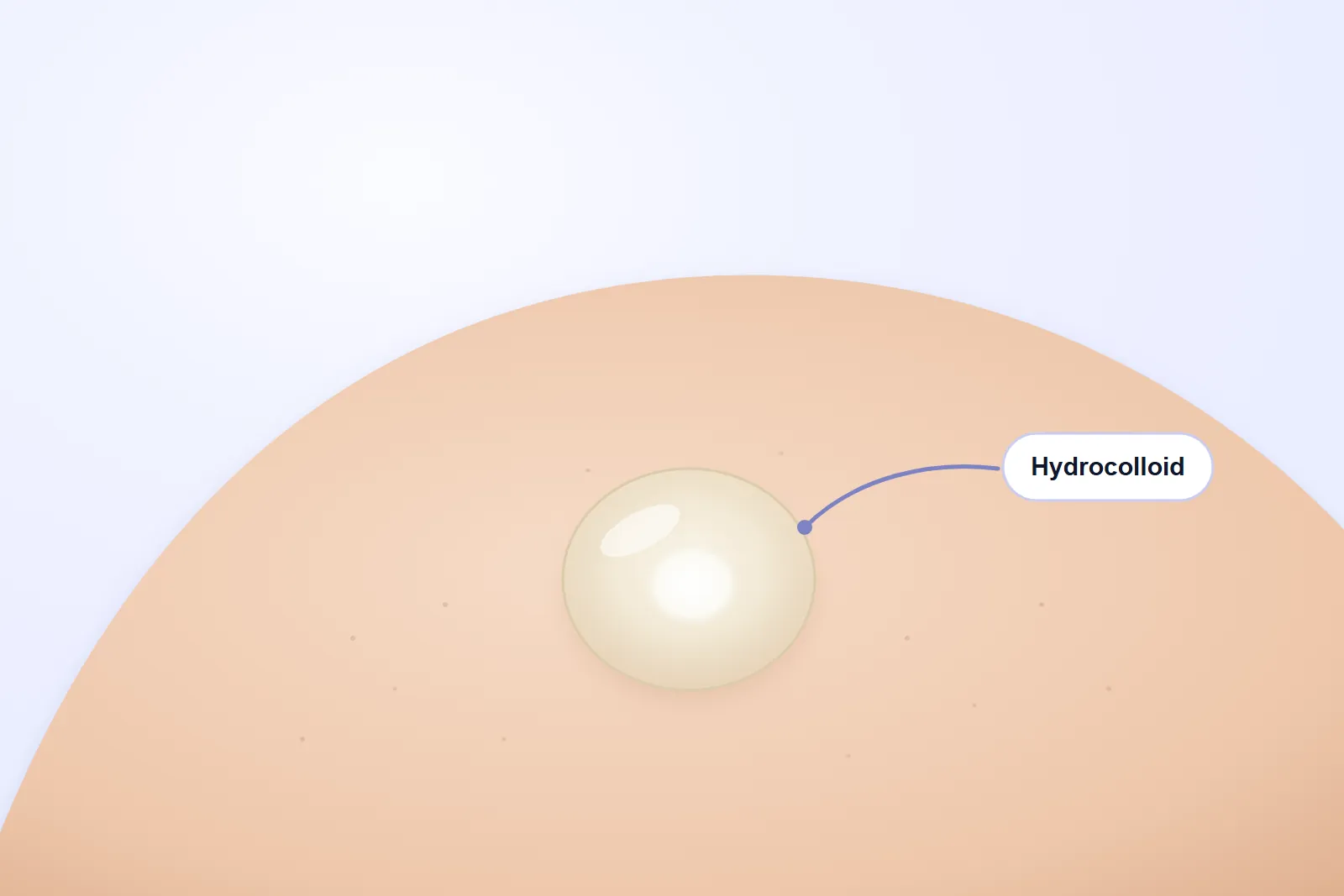
Pimple patches work by covering a pimple with hydrocolloid, a gel first made for wound care. The gel absorbs fluid, like pus and oil, and turns white as it swells. The patch also keeps a moist, closed cover over the spot, which blocks fingers, bacteria and some sun while the skin recovers underneath.
“Pimple patches are really just wound healing dressings for a very specific type of lesion”
Amy Kassouf, MD, dermatologist, Cleveland Clinic
Hydrocolloid is a mix of long-chain polymers, sugars and proteins that turns into a gel when it meets water (Nguyen 2025). It has been in hospital dressings since 1982 in the UK and 1983 in the US, so a pimple patch is basically wound care that got a tiny haircut and a marketing team. [Salutes the tiny haircut.]
Cleveland Clinic boils it down to two jobs, absorbing fluids “to help drain picked-open zits and unclog pores” and covering the spot “to protect against infection or any (further) picking” (Cleveland Clinic). The second job is the one I need most, because my hands have the self-control of a toddler at a birthday party.
University Hospitals dermatologist Kord Honda, MD, hedges the first job with one honest word: “Theoretically, they draw out moisture from the area” (University Hospitals). Theoretically. It’s the most honest word in skincare, and it has never once appeared on a box I bought.
Do pimple patches actually work?
Yes, on the right pimple. In the only published randomized trial, 20 people with mild to moderate acne, hydrocolloid patches cut redness and overall acne severity more than plain skin tape within a week. That’s a small, short study, and no trial shows patches prevent new breakouts or clear acne across the face.
Here’s what that 2006 trial actually measured. Ten people wore a 3M hydrocolloid acne dressing and ten wore ordinary skin tape, changed every two days for up to a week (Chao 2006). Twenty people. I have been in bigger group chats, and muted most of them. The patch group’s severity score fell from 1.8 to 0.43, against 1.08 to 0.8 for the tape, with more improvement in redness, oiliness and dark marks at days 3, 5 and 7. So the question it answered was “is a pimple patch better than a sticker?”, and the patch won. [Hands the patch a very small trophy.]
One more number from that trial surprised me. Only 7.4% of UVB light got through the hydrocolloid, against 38% through the tape, so a patch doubles as a tiny sun umbrella for a healing spot. I have never once remembered sunscreen on my chin, so I’ll take any help going.
A 2024 conference abstract found patches plus gentle washing beat washing alone on redness and size over 14 days, but the full peer-reviewed paper wasn’t out yet (Nguyen 2025). A conference abstract is a trailer, not the movie, and I have been burned by trailers before.
“Interestingly, despite the growing popularity and demand among consumers for HDs in the form of patches, there is limited published research on the direct benefits of HDs in the treatment of acne vulgaris.”
Nguyen et al., Journal of Clinical Medicine, 2025
(“HDs” is hydrocolloid dressings. I had to scroll up to check, twice.) Dr. Kassouf is blunter about the bigger picture: “For overall acne treatment, there is little use for pimple patches,” she told Cleveland Clinic, because “They cannot prevent acne from coming, nor can they clear clogged pores or other precursors to acne flares.” A patch is a bandage, not a plan. I found this out by buying a 72-pack as if it were a plan.
What is the white stuff on a pimple patch?
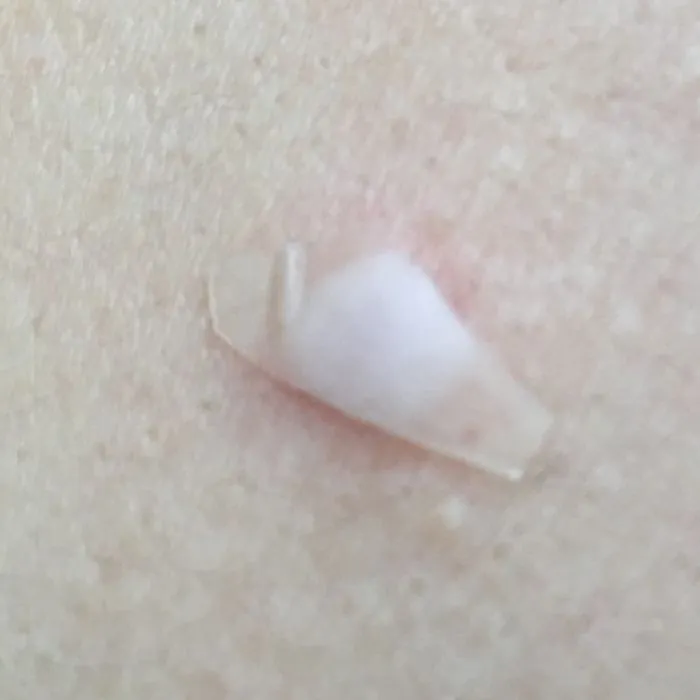
The white stuff is mostly the hydrocolloid itself, swollen with water it has pulled from your skin. Some of it can be pus or fluid from the pimple, especially if the spot had a head or was popped. A big white bump on the patch doesn’t prove it pulled out a lot of gunk.
A dermatologist-reviewed explainer in theSkimm puts it plainly: “Hydrocolloid patches draw water from the skin and turn white after a period of time”, and while some of it may be pus, “in most cases, it’s simply hydrocolloid that’s hydrated” (theSkimm).
This was devastating news for the Dome Report. Weeks of breathless morning coverage, and I had mostly been reporting on water. [Takes off the weather-forecaster blazer. Folds it sadly.] The useful takeaway: judge the pimple under the patch, not the size of the white bump on top.
How long should you leave a pimple patch on?
Leave a pimple patch on for at least 6 hours and no more than about 12, then swap in a fresh one if the spot still needs it. Overnight is the easiest window. Take it off sooner if it turns fully white, starts lifting at the edges, or the skin around it itches or stings.
Dermatology Physicians of Connecticut says most patches are worn “for 6–12 hours or overnight”, and to remove one “once it turns opaque or white and no longer adheres well to the skin” (Dermatology of CT). Board-certified dermatologist Geeta Yadav, MD, sets the ceiling: “Beyond 12 hours, you’ll want to remove it and put a fresh one on” (theSkimm). Twelve hours is also, coincidentally, how long I can go without checking a patch I told myself I wouldn’t check.
The reason for the limit is the glue, which, it turns out, has a curfew. Dendy Engelman, MD, warns “The adhesive on that patch could potentially irritate over time” (theSkimm), and Dr. Honda says “The patch should be replaced daily” (University Hospitals). The only trial changed patches every two days, so the 12-hour rule is practitioner consensus, not a tested wear time. Sensible consensus, though.
The Dome Report now runs on a strict schedule: patch on at bedtime, report at breakfast, patch off. No 24-hour coverage. The network (me) has been informed.
How do you use a pimple patch?
Wash and fully dry the spot, then press the patch on before any serum, moisturizer or makeup, so it sticks to bare skin. Pick a size that covers the whole bump. Leave it on for 6 to 12 hours, peel it off slowly, then cleanse and carry on with your usual routine.
Step by step:
- Wash the area with a gentle cleanser, and wash your hands too.
- Dry it completely. Cleveland Clinic notes the adhesive “won’t stick as well to wet skin” (Cleveland Clinic).
- Patch first, products after. Creams or serums underneath stop it sticking (Dermatology of CT).
- Leave it 6 to 12 hours, then peel it off slowly and cleanse.
- New to patches with a glue allergy? Dr. Yadav suggests testing one on your inner forearm first (theSkimm).
That’s the whole list. It is shorter than the back of a shampoo bottle, and I still read it twice.
If you’ve already popped it, clean the area, then patch it. Dr. Kassouf says “if you’ve already gone down that road, a pimple patch may help your skin recover and minimize damage” (Cleveland Clinic). I appreciate a doctor who knows exactly which road we all went down.
Do pimple patches work on blackheads?
Not really. A blackhead is an open pore plugged with oil and dead skin, not a pocket of fluid, so there’s little for the hydrocolloid to absorb. A patch may lift a little surface oil, but it won’t clear the plug. Salicylic acid or a retinoid, used daily for six to eight weeks, works better.
Cleveland Clinic says patches “don’t offer much help when it comes to eliminating blackheads” (Cleveland Clinic), and Dermatology of CT lists blackheads and closed comedones under “less effective”. To be fair, dermatologists don’t all agree: one told Healthline that patches aim at “pus-filled bumps, blackheads, and whiteheads”. I, too, contain contradictions, mostly about snacks.
The American Academy of Dermatology’s advice for blackheads is short: “The black dots aren’t dirt, so resist scrubbing” (AAD), and give a treatment six to eight weeks. If the dots on your nose are flat and gray, they may be sebaceous filaments instead, and our guide to sebaceous filaments and hydrocolloid tape on the nose covers why the peel-and-gasp trick doesn’t last. [Quietly puts the nose-sized patch back in the box.]
Closed bumps with no head are a similar story. Cleveland Clinic says patches “don’t work as well on closed pimples” (Cleveland Clinic), which is most whiteheads, and our guide to closed comedones covers what clears those. For a daily pore-clearing ingredient, our comparison of AHA vs BHA exfoliants explains why salicylic acid gets into oily pores.
Do pimple patches work on cystic acne?
Plain hydrocolloid patches don’t reach cystic acne, because cysts and nodules sit deep under the skin with no opening for fluid to come out. A patch can still stop you picking at the spot. For a painful deep pimple, a dermatologist can inject a small dose of steroid (cortisone) to shrink it fast.
“It’s unlikely these patches penetrate to the level that will be able to help cystic acne,”
Lavanya Krishnan, MD, board-certified dermatologist, in Healthline
Dermatology of CT agrees: “Deep acne forms under the skin and cannot easily be absorbed by the patch” (Dermatology of CT). So a patch on a deep cyst is mostly a very small, very sincere “do not disturb” sign. It works on me about as well as the “do not disturb” setting on my phone, which I override roughly every nine minutes.
The American Academy of Dermatology’s plan for a deep, painful pimple starts with hands off, then a warm, damp washcloth “for 10-15 minutes, three times daily” to help bring it closer to the surface (AAD). Once it’s there, the AAD says an over-the-counter active ingredient works better, and “a hydrocolloid acne patch can be applied to protect your skin and improve healing.” [Switches to serious face.] If you get several deep, painful pimples, or one that won’t budge, see a board-certified dermatologist, because cystic acne can scar.
Are microneedle or salicylic acid patches better than plain ones?
Nobody has shown that yet. A 2025 review found no studies showing that adding ingredients to hydrocolloid patches helps. Microneedle patches look promising in small trials, but many store versions may not fully pierce the skin. Plain hydrocolloid is the best-studied, cheapest and gentlest choice for surface pimples.
The review is direct: “there are currently no studies suggesting that the addition of other compounds to HDs would be beneficial” (Nguyen 2025). Dr. Honda adds that salicylic acid “can be helpful for acne, but it’s best for preventing acne, rather than treating individual pimples” (University Hospitals). So salicylic acid in a spot patch is a bit like hiring a gardener for one plant. I would know. I own exactly one plant, and it is plastic.
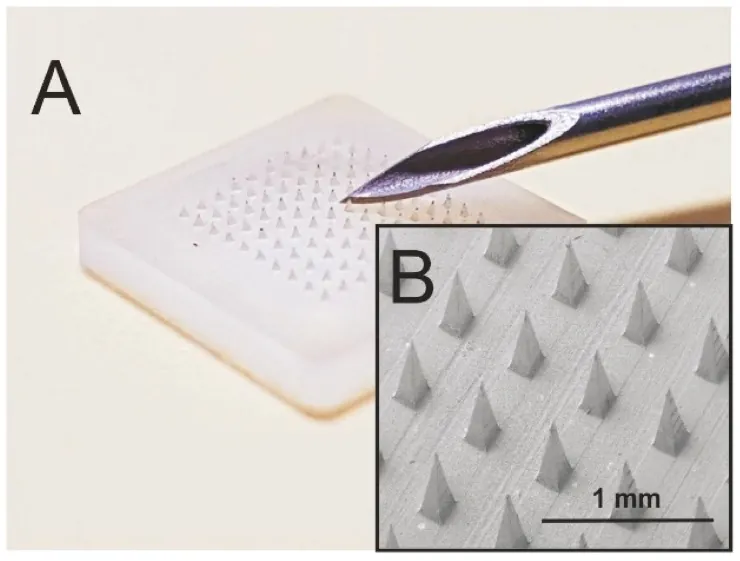
Microneedle patches are covered in tiny points that Dr. Honda says “are supposed to deliver medication, such as salicylic acid, deeper into the skin” (University Hospitals). “Supposed to” is doing a lot of lifting there. A 2025 lab test of 10 cosmetic microneedle patches, with needles about 0.2 to 0.5 mm tall, found that “only 7 patches demonstrated ex vivo porcine skin insertion”, and just 1 went in fully (Lee 2025). Seven out of ten is my success rate with parallel parking, and nobody sells me that as a breakthrough. That’s pig skin in a lab, not faces, so read it as a warning about quality, not a verdict on every brand.
The best microneedle result so far is a prescription-style one. In a 28-day randomized trial of 35 people, patches carrying a steroid called triamcinolone cleared inflamed spots in a median of 4.6 to 5.25 days, against 8.1 days with no treatment, and even plain microneedles with no drug took 6.7 days (Thantaviriya 2023). Those steroid patches aren’t what you’ll find on a drugstore peg. They’re what the dermatology aisle would sell if it had a waiting room.
Can pimple patches irritate your skin?
Yes, sometimes. The adhesive is the usual culprit, and medicated patches add ingredients like salicylic acid or tea tree oil that can redden or dry sensitive skin. Stop if you get itching, a rash or redness around the patch, and see a dermatologist if it doesn’t settle quickly.
Dr. Honda’s view: “The main irritant is likely to be the adhesive,” and some patches also contain latex or other polymers that can trigger allergic reactions (University Hospitals). The 2025 review mentions case reports of allergic rashes under hydrocolloid dressings, linked to a sticky ingredient made from tree rosin, and warns that pulling dressings off again and again may disrupt the skin’s outer layer (Nguyen 2025). In plain words: stop peeling it up to check. I felt that one personally. If the skin around your patches feels tight, stingy or flaky, our guide to repairing your skin barrier is the next read.
Which brings us to the Dome Report’s final broadcast. It has been cancelled and replaced with a much duller segment called Is The Skin Around It Happy, and critics (me) are calling it responsible. [Signs off. Turns off the bathroom light. Turns it back on to check one more time.]
Frequently asked questions
Do pimple patches work?
Yes, on surface pimples, especially ones with a head or ones that have been popped. A small 2006 trial found they reduced redness and severity more than plain tape within a week. They don’t prevent new breakouts.
How fast do pimple patches work?
Often within one night. Cleveland Clinic says a blemish may look smaller and less inflamed when you peel the patch off. In the 2006 trial, the difference from plain tape showed up by day 3 and held through day 7.
Can you put a pimple patch on a popped pimple?
Yes. Clean the area gently first, let it dry, then apply the patch. It protects the open spot and can help it recover with less damage.
Can you wear a pimple patch under makeup?
Yes, if it’s a thin patch. Many are made thin enough to wear in the day under makeup. Put the patch on clean, dry skin first, then apply makeup.
Do pimple patches work on whiteheads?
They work best on whiteheads that have come to a head. Closed whiteheads with no opening respond less, because there’s little fluid for the patch to absorb.
Can you reuse a pimple patch?
No. Once a patch has absorbed fluid or lost its stick, throw it away and use a fresh one.
Your next step
Keep a box of plain hydrocolloid patches for surface pimples with a head, and wear each one for 6 to 12 hours. For blackheads and closed whiteheads, use a daily pore-clearing ingredient for six to eight weeks instead. If you get deep, painful pimples often, book a board-certified dermatologist.

Written by the Trusted Skincare Editorial Team
We research at-home beauty devices and skin treatments and link every claim to a published study, a regulator or a named expert. Last updated Sunday 27 September 2026.
Sources
- Chao et al. 2006, A randomized trial of a hydrocolloid acne dressing (Journal of Cosmetic Science)
- Nguyen et al. 2025, Narrative review of hydrocolloids in dermatology (Journal of Clinical Medicine)
- Thantaviriya et al. 2023, Detachable microneedle patch with triamcinolone for inflammatory acne (Clinical, Cosmetic and Investigational Dermatology)
- Lee et al. 2025, Integrity of commercial microneedle patches: innovation or fad? (Drug Delivery and Translational Research)
- Cleveland Clinic: Can pimple patches make a zit go away?
- University Hospitals: Are pimple patches really a quick fix for acne?
- Dermatology Physicians of Connecticut: Acne patch FAQs
- American Academy of Dermatology: Tips to treat a deep, painful pimple
- American Academy of Dermatology: How to treat different types of acne
- Healthline: Do those pimple stickers actually work?
- theSkimm: How long should you leave on a hydrocolloid patch?