

On this page
- Smile lines vs marionette lines vs lip lines at a glance
- What are smile lines?
- What causes smile lines?
- Can you get rid of smile lines naturally?
- Is filler the best treatment for smile lines?
- Does Botox work for smile lines?
- Smile lines treatment options compared
- An at-home option: needle-free RF
- Your next step
Quick answer: To get rid of smile lines, the lines from your nose to the corners of your mouth, the standard fix is hyaluronic acid filler, which restores lost cheek volume and lasts about 4 to 12 months. Creams and retinoids smooth the skin on top but can’t refill a fold. Daily sunscreen and not smoking slow them down.
We read 19 studies and sources on how to get rid of smile lines, from a 2003 filler trial in 138 people to a 2025 study that measured the folds of 150 faces, so every claim below links to where it came from. (I also tried to stop smiling for one full day to protect my smile lines. I called it the Smile Ban. It lasted until 9:14 a.m., when someone posted a dog in a tiny raincoat.)
Smile lines vs marionette lines vs lip lines at a glance
| Smile lines | Marionette lines | Lip lines | |
|---|---|---|---|
| Medical name | Nasolabial folds | Melomental folds | Perioral lines |
| Where they run | Sides of the nose to the corners of the mouth | Corners of the mouth down toward the chin | Small vertical lines on and above the lips |
| What it really is | A fold where cheek volume has shifted | A fold plus sagging at the jawline | Creases in the skin itself |
| Best-studied fix | Hyaluronic acid filler | Filler, though trial data is thin | Filler for deeper lines, retinoids for fine ones |
| Lasts | About 4 to 12 months per filler session | About 4 to 12 months per filler session | Varies by product |
Sources: Cleveland Clinic on nasolabial folds, Cleveland Clinic on marionette lines, FDA on dermal fillers, AAD fillers FAQ, Stefura 2021.
What are smile lines?
Smile lines are the creases that run from the sides of your nose to the corners of your mouth. Doctors call them nasolabial folds, and many people call them laugh lines. They show up first when you smile, then, with age, they stay when your face relaxes. They are a fold of cheek, not only a crease in skin.
“Nasolabial folds are creases in your skin extending from both sides of your nose to the corners of your mouth.”
Cleveland Clinic
Cleveland Clinic adds that when you’re younger, “the folds may appear only when you smile or laugh, then disappear as your face relaxes” (Cleveland Clinic). Which is the exact reasoning behind the Smile Ban, and I’d like that on the record before anyone laughs. (You’re smiling. I can tell. It’s fine. Mine got lifted too.)
The names get mixed up constantly, even on page one of Google, where one clinic blog puts smile lines on the upper and lower lips. The lines that drop from the corners of your mouth toward your chin are marionette lines, a different fold with a different fix, and our marionette lines guide covers them. The tiny vertical lines on the lip itself are lip lines, which behave like fine lines and answer to different products. Three lines, three names, one very confused search bar, and I have typed all three into it in a single evening.
What causes smile lines?
Smile lines deepen because the face underneath them changes. The fat pads in your cheeks slide down and shrink, the bone beside your nose retreats, and the skin loses collagen and elastin, the proteins that keep it springy. Sun, smoking and big weight changes speed it up. Smiling makes the crease, but volume shifts make it stay.
Here’s the part nobody on the first page explains. Researchers who measured 150 faces aged 21 to 70 put it plainly.
“Despite its clinical importance, the NLF is a complex anatomical structure rather than simply a wrinkle.”
Quan et al. 2025, Aesthetic Surgery Journal Open Forum
That study found the folds start changing between the twenties and the thirties, with the lower part deepening most from the forties to the sixties as a cheek fat pad drops (Quan 2025). A CT study of cadaver heads found “an inferior migration of the midfacial fat compartments” with age, which is a very formal way of saying the cheek fat moved downstairs (Gierloff 2012). Earlier dissection work showed face fat sits in separate compartments, and the nasolabial fold is “a discrete unit with distinct anatomical boundaries” (Rohrich and Pessa 2007). So the fold is the edge where one compartment sits on the next. My Smile Ban, it turns out, was guarding the wrong door.
Cleveland Clinic lists the other drivers: flattening cheekbones, gravity, less collagen and elastin, smoking, sun damage, and big weight loss or gain (Cleveland Clinic). I read that list on a sunny patio with no hat on, which felt a lot like being caught. Smoking has the most striking evidence. In 79 pairs of identical twins where only one smoked, “Smoking twins compared with their nonsmoking counterparts had worse scores for upper eyelid skin redundancy, lower lid bags, malar bags, nasolabial folds” (Okada 2013). Same genes, same birthday, different folds. I have never been out-argued so efficiently by a twin festival.
Can you get rid of smile lines naturally?
Not fully. No cream, exercise or habit has been shown to refill a deep fold. What natural steps can do is slow them down and soften the skin on top: daily SPF 30 sunscreen, not smoking, and a nightly retinoid. One small study found face exercises improved cheek fullness, but it had no control group.
[Switches to serious face.] Here’s how each natural fix stacks up, best evidence first.
Sunscreen, every day. In a trial of 903 adults followed for 4.5 years, “The daily sunscreen group showed no detectable increase in skin aging after 4.5 years” (Hughes 2013). It doesn’t fill a fold, but it protects the collagen around one. It’s also the cheapest step on this whole page, and I still forget it on cloudy days like it’s a surprise quiz.
Not smoking. See the twins above. Cleveland Clinic says smoking “destroys collagen and elastin in your skin” (Cleveland Clinic). No joke here. Quitting is hard and anyone doing it deserves applause, not a punchline.
A retinoid at night. In a 24-week trial on aged skin, the researchers concluded “Topical retinol improves fine wrinkles associated with natural aging” and measured more collagen in treated skin (Kafi 2007). The catch: it tested arms, in people with an average age of 87, and it smooths fine lines on the surface. It cannot put volume back into a cheek. (I tested this theory with a very hopeful pat. The cheek did not inflate.) If you’re picking one, our retinal vs retinol guide compares the strengths. I own three retinoids and use one, so learn from me and buy the one.
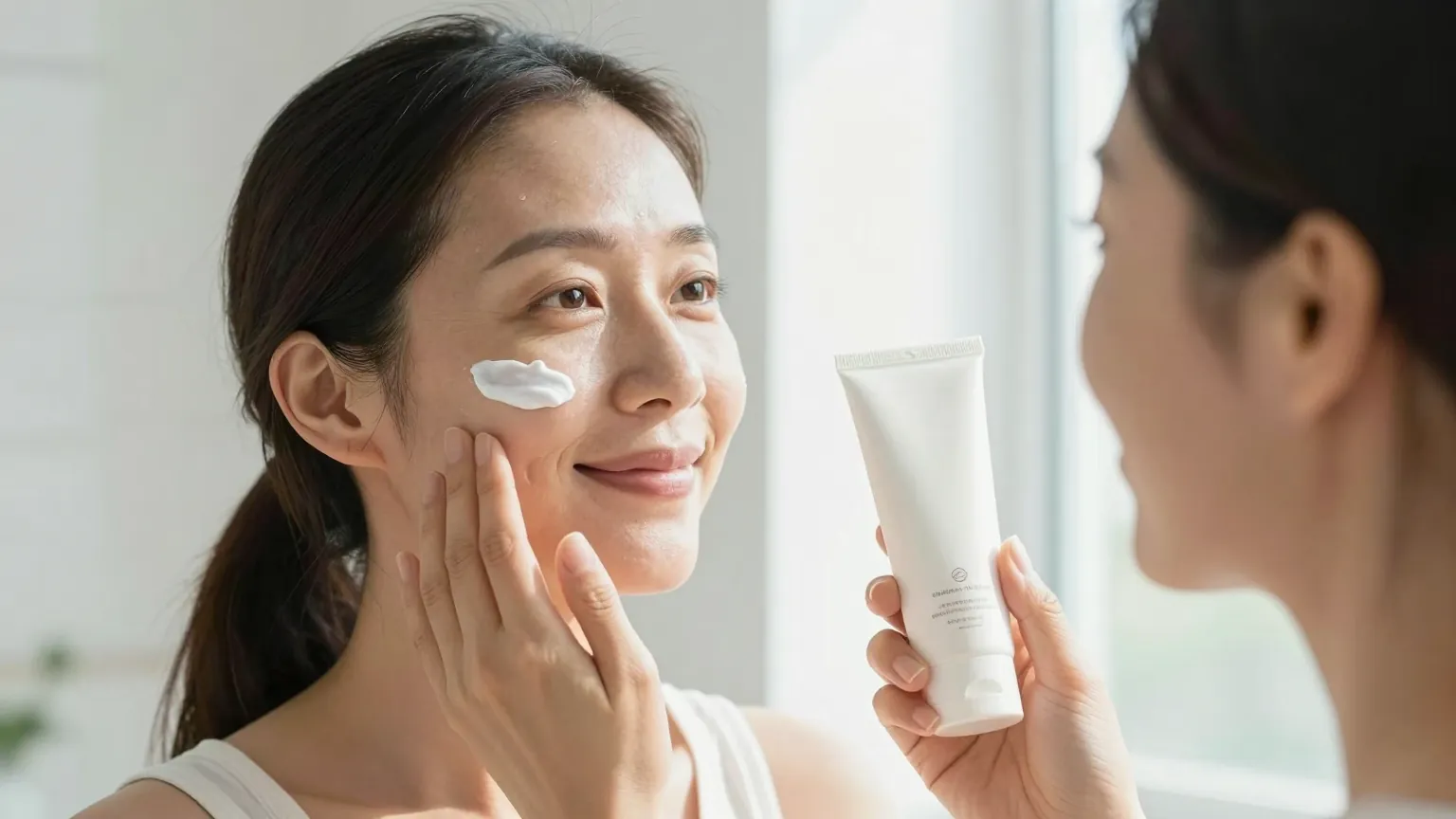
Face exercises. The best-known trial, from Northwestern, had women do 30 minutes of facial exercises a day for 8 weeks, then every other day to week 20 (Alam 2018). Thirty minutes a day. I can’t commit to thirty minutes of anything that isn’t a TV episode. Blinded raters scored upper and lower cheek fullness as better, and the women’s estimated age dropped from 50.8 to 48.1 years. Honest label: only 16 of 27 finished, all were women, and there was no control group. Cleveland Clinic also suggests a simple mouth-corner stretch, held for 10 seconds and repeated 10 to 25 times (Cleveland Clinic). I tried it, and as a bonus discovered I can’t do anything for 10 seconds without checking my phone.
Sleeping on your back and drinking water. Cleveland Clinic suggests back sleeping so gravity works against the fold, but we found no trial that measured it, so treat it as practitioner advice. We found no trial showing that drinking more water shrinks smile lines either. Drink it anyway. Water has never once let me down, which is more than I can say for a jade roller.
Is filler the best treatment for smile lines?
Yes, for most people. Hyaluronic acid filler is FDA-approved for nasolabial folds and is the most common treatment for them. It puts back the volume the fold lost, works right away, and lasts about 4 to 12 months, with some products holding a year or more in trials. The average fee is about $715.
“Currently, nasolabial fold area wrinkles are most commonly treated with tissue fillers.”
Stefura et al. 2021, a meta-analysis of randomized trials, Aesthetic Plastic Surgery
That meta-analysis pooled randomized trials on a 5-point fold severity scale. The average score went from 3.23 before treatment to 1.79 at one month, 2.02 at six months and 2.46 at a year, so the result holds for months and then fades slowly (Stefura 2021). In a 292-person trial, 81% of folds treated with Juvederm Ultra Plus kept a clinically meaningful correction past 9 months, and the authors described it as “lasting for a year or more” (Pinsky 2008). A year or more is longer than any houseplant has survived in my care. An older 138-person trial found Restylane outlasted collagen filler at 6 months (Narins 2003). Those are real numbers, which is more than I can say for my skincare budget spreadsheet.

How long filler for smile lines lasts: the American Academy of Dermatology says hyaluronic acid gel lasts 4 to 12 months, poly-L-lactic acid 1 to 3 years, and PMMA is permanent (AAD). The American Society of Plastic Surgeons lists hyaluronic acid for “Deep smile lines that run from the side of the nose to corners of the mouth” (ASPS). Hyaluronic acid can also be dissolved if you don’t like the result, which is a feature I would pay extra for in several haircuts.
What it costs: the ASPS puts the average cost of hyaluronic acid filler at $715 and non-hyaluronic filler at $901, and says insurance doesn’t cover it (ASPS).
The safety part. The meta-analysis found the most common side effects were lumpiness, tenderness, swelling and bruising (Stefura 2021). The rare one is serious. The FDA says “The most concerning risk associated with the use of dermal fillers is unintentional injection into a blood vessel”, which can cause tissue death, vision problems including blindness, and stroke. It also says “Do not purchase dermal filler products online, because they could be counterfeit products or products that are not approved for use in the U.S.” (FDA). Book a board-certified dermatologist or plastic surgeon. This is the one paragraph where I don’t do bits.
Does Botox work for smile lines?
Rarely, and it isn’t the standard. Botox relaxes muscles, but smile lines are mostly a volume problem, so there is little for it to fix. Smile lines aren’t among the FDA-approved Botox uses the American Academy of Dermatology lists, and the muscles inside the fold lift your upper lip, so relaxing them risks changing your smile.
The AAD lists the FDA-approved dermatology uses as frown lines between the eyebrows, crow’s feet and underarm sweating, with results lasting “about 3 to 4 months” (AAD). Smile lines aren’t on that list. I checked twice, which is two more times than I check the expiry date on my sunscreen. (Our crow’s feet guide covers the places where Botox is the right tool.) Cleveland Clinic says Botox “also may be used” to relax a muscle that contributes to the fold, with results for a few months (Cleveland Clinic). So it exists. It’s just a side door, not the front one.
The reason is anatomy. A cadaver study found the muscle that lifts the upper lip and flares the nostril inserts into the inner part of the fold, and another lip-lifting muscle inserts into its middle third (Snider 2016). That first muscle’s Latin name is levator labii superioris alaeque nasi, which is longer than my grocery list and much better organized. Weaken those and you can lengthen the upper lip or flatten a smile. That’s the widely shared worry among injectors, practitioner consensus rather than a trial result. In other words, Botox here is basically a professional Smile Ban, and I already know how mine went.
A surgeon who reported more than 1,000 Botox injections into the folds over ten years summed it up: “The keys to achieving adequate correction and satisfied patients when treating the nasolabial fold are proper diagnosis of what is causing the fold and careful patient selection” (Kane 2003). That is one sentence, and I needed a snack halfway through it. Translation: it can help a small group whose fold comes from a strong muscle pull, in expert hands. For everyone else, filler is the tool the trials back.
Smile lines treatment options compared
Here’s every route side by side. (I asked for a row called “smile less”. Every expert said no. The Smile Ban has been rejected by science.)
| Option | What it reaches | How long it lasts | Evidence for the fold |
|---|---|---|---|
| Daily sunscreen | Skin, slows new damage | Ongoing habit | Strong for skin aging overall, not fold-specific |
| Retinoid | Skin surface, fine lines | Ongoing, judge at 3 to 6 months | Good for fine wrinkles, can’t refill volume |
| Face exercises | Cheek muscles | Ongoing | One small trial, no control group |
| Hyaluronic acid filler | Lost volume in the fold | About 4 to 12 months | Strongest, many randomized trials |
| Botox | Lip-lifting muscles | About 3 to 4 months | Thin, not FDA-approved for this |
| Skin tightening (laser, ultrasound, RF) | Collagen in the skin | Months, repeat sessions | Modest, best for mild folds and loose skin |
| Cheek lift or facelift | Repositions tissue | Years | Longest-lasting, with surgery and downtime |
Sources: AAD fillers FAQ, AAD Botox, Stefura 2021, Hughes 2013, Kafi 2007, Alam 2018, Cleveland Clinic.
Cleveland Clinic lists lasers, ultrasound and radio waves as skin-tightening options that “stimulate collagen production” (Cleveland Clinic). In clinics, RF microneedling such as Morpheus8 is a common version, and our Morpheus8 guide covers what it does and costs. (The name sounds like a robot I begged for in a toy aisle once. It is not a robot.) These tighten skin. They don’t replace a cheek’s worth of lost volume, which is why clinics often pair them with filler, the way I pair a salad with fries and call it balance.
Cleveland Clinic is also honest about the ceiling: “There’s no way to prevent nasolabial folds permanently” (Cleveland Clinic). Every option above is maintenance. Some of it just comes with a receptionist.
An at-home option: needle-free RF
If you want something between a serum and a clinic (the middle child of skincare, and I relate), at-home radiofrequency (RF) devices warm the skin to encourage collagen. The best independent evidence is a 2022 randomized split-face trial: 32 women aged 35 to 60 finished 12 weeks of a home RF device, 6 minutes a session on most days, on one side of the face and a cream on the other.
“the experimental side had significantly greater improvement in forehead wrinkles, crow’s feet, nasolabial folds, facial pores and sagging of the lower part of the face than the control side at W12.”
Shu et al. 2022, Dermatology and Therapy
That’s one trial of one device, and the device maker paid the journal’s publishing fee (Shu 2022). The needle-free device we cover most is the VEAUTY Dot: 144 electrodes that sit on the surface of the skin and never pierce it, sold as a cosmetic device, rated 4.8 out of 5 from 1,163 reviews on its own store. Those are customer reviews, not a clinical trial, and results vary. To be plain about it: for a deep smile line, filler is the standard and has much stronger evidence. An at-home device is the slow, steady upkeep lane for skin quality, about 15 minutes a few times a week on the sofa. (It is also the only skincare step you can do while laughing at the TV, which the Smile Ban would never have allowed.)
Frequently asked questions
Can smile lines go away on their own?
No. Once smile lines stay visible at rest, they don’t fade by themselves. Sunscreen and not smoking slow them down, and filler or surgery are the options that visibly reduce a deep fold.
Does smiling cause smile lines?
Partly. Smiling creases the skin along the fold, but the fold deepens mainly because cheek fat shifts down and shrinks, bone changes and skin loses collagen with age. Not smiling won’t prevent them.
How long does filler for smile lines last?
Hyaluronic acid filler usually lasts 4 to 12 months, according to the American Academy of Dermatology. In one trial, 78% of folds treated with Juvederm Ultra Plus still showed a meaningful improvement beyond one year.
How much does filler for smile lines cost?
The American Society of Plastic Surgeons puts the average cost at $715 for hyaluronic acid filler and $901 for non-hyaluronic acid filler. Insurance doesn’t cover it, and deeper folds may need more product.
Is Botox good for smile lines?
It isn’t the standard. Botox is not FDA-approved for smile lines, and the muscles in the fold lift the upper lip, so relaxing them can change your smile. A specialist may use it in select cases. Filler has far stronger evidence.
At what age do smile lines appear?
A 2025 study of 150 people found the folds start changing between the twenties and thirties, with the lower part deepening most from the forties to the sixties. Men showed earlier changes than women.
Your next step
Start with daily SPF 30 sunscreen and a nightly retinoid for the skin on top, and give the retinoid 3 to 6 months. If the fold itself bothers you, book a consultation with a board-certified dermatologist or plastic surgeon about hyaluronic acid filler. If the deeper lines run from your mouth corners toward your chin, read our marionette lines guide next. As for me, the Smile Ban is officially lifted, and I’m told my face looks much better laughing at that dog in the raincoat anyway.

Written by the Trusted Skincare Editorial Team
We research at-home beauty devices and skin treatments and link every claim to a published study, a regulator or a named expert. Last updated Wednesday 7 October 2026.
Sources
- Cleveland Clinic: Nasolabial folds
- Quan et al. 2025, Quantitative Assessment of Nasolabial Fold Characteristics Across Age Groups (Aesthetic Surgery Journal Open Forum)
- Gierloff et al. 2012, Aging changes of the midfacial fat compartments (Plastic and Reconstructive Surgery)
- Stefura et al. 2021, Tissue fillers for the nasolabial fold area: a meta-analysis (Aesthetic Plastic Surgery)
- Pinsky et al. 2008, Juvederm injectable gel multicenter study (Aesthetic Surgery Journal)
- FDA: Dermal fillers (soft tissue fillers)
- American Academy of Dermatology: Fillers FAQs
- American Academy of Dermatology: Botulinum toxin therapy overview
- American Society of Plastic Surgeons: How much do dermal fillers cost?
- Okada et al. 2013, Facial changes caused by smoking in identical twins (Plastic and Reconstructive Surgery)
- Hughes et al. 2013, Sunscreen and prevention of skin aging (Annals of Internal Medicine)
- Shu et al. 2022, At-home radiofrequency split-face trial (Dermatology and Therapy)