

On this page
- Types of textured skin at a glance
- What is skin texture?
- What causes textured skin?
- Why is the skin on my face rough?
- How do you get rid of textured skin?
- Do AHAs and BHAs help skin texture?
- Do retinoids improve skin texture?
- Can sunscreen improve uneven skin texture?
- Does moisturizer help textured skin?
- When should you see a dermatologist about skin texture?
- How long does it take to improve skin texture?
- Your next step
Quick answer: Skin texture is how smooth or rough your skin looks and feels. Textured skin usually comes from clogged pores, dryness, sun damage, keratosis pilaris or acne scars. Daily SPF 30, a moisturizer, one exfoliating acid and a retinoid improve most surface texture over 3 to 6 months. Dented acne scars need a dermatologist.
We read 17 studies and sources, from a 1988 tretinoin trial to a 2025 review of keratosis pilaris, so every claim below links to where it came from. (I also own seven exfoliating products. I call them the Scrub Committee. They meet on my bathroom shelf every night and have never once agreed on anything.)
Types of textured skin at a glance
| What it looks and feels like | Usual cause | What helps first | |
|---|---|---|---|
| Closed comedones | Small skin-colored bumps, mostly forehead, chin and cheeks | Pores plugged with oil and dead skin cells | A retinoid such as adapalene, or salicylic acid |
| Visible pores | Pores you can see from arm’s length, often nose and cheeks | Oil, clogging, sun damage, skin losing firmness | Salicylic acid, retinol, daily SPF 30 |
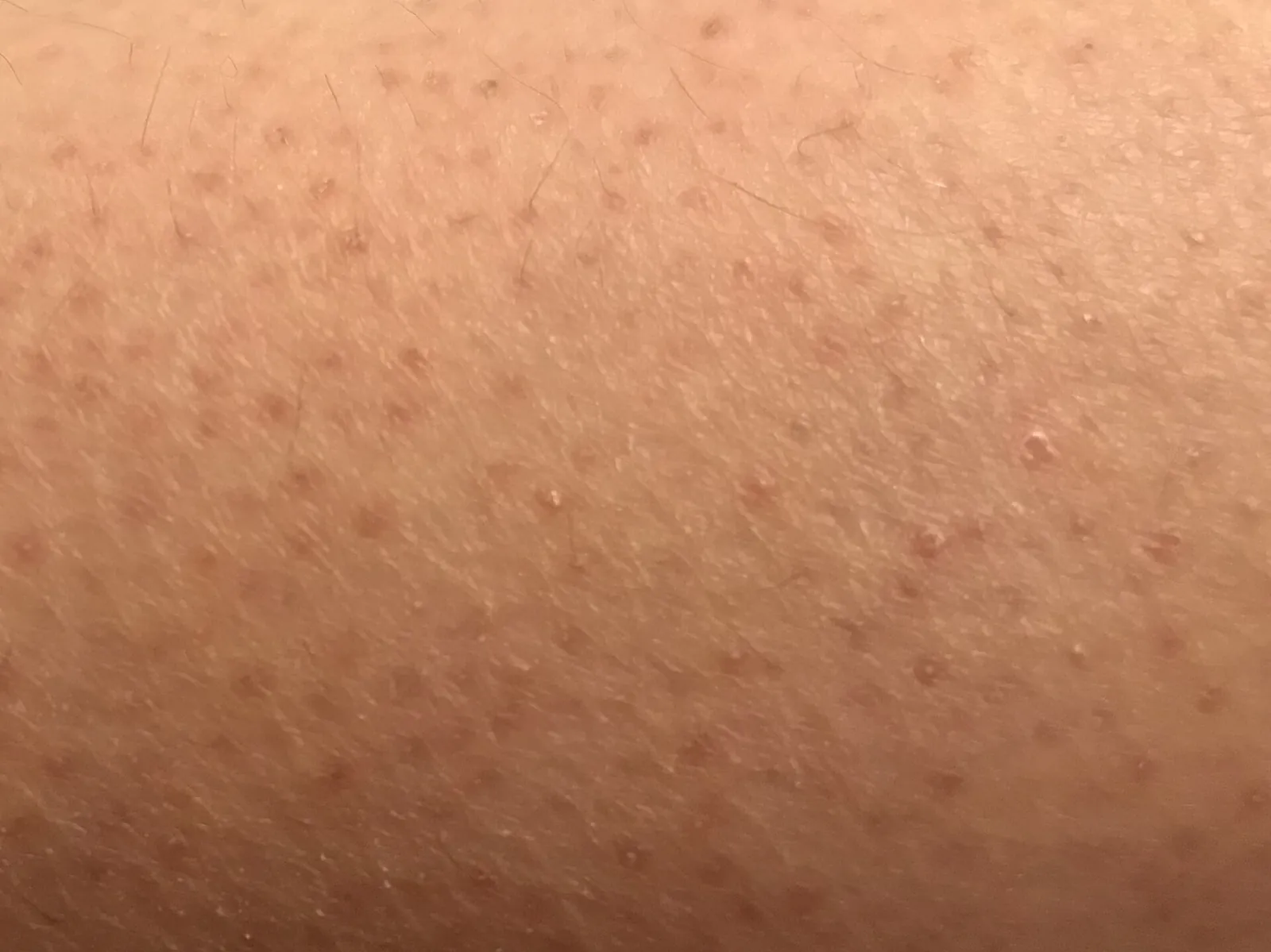
| Keratosis pilaris | Tiny rough bumps like goose bumps, on arms, thighs and sometimes cheeks | Keratin, a skin protein, plugging hair follicles | A urea or lactic acid moisturizer |
| Dry, rough patches | Tight, flaky, sandpaper feel | Too little moisture, hot water, dry air | Moisturizer on damp skin |
| Sun damage | Rough, leathery or uneven surface | Years of UV exposure | Daily SPF 30, a retinoid, an AHA |
| Acne scars | Dents or wavy skin that stays put | Past inflamed acne | Dermatologist procedures |
Sources: AAD on acne types, AAD on large pores, Cleveland Clinic on keratosis pilaris, Cleveland Clinic on dry skin, AAD on acne scar treatment.
What is skin texture?
Skin texture is how smooth or uneven the surface of your skin looks and feels. Some texture is completely normal: pores, fine lines and the odd bump are part of healthy skin. Textured skin usually means bumps, rough or flaky patches, visible pores or dents that stand out more than you would like.
“Although most people strive for that airbrushed finish, almost everyone has texture to some degree, whether it’s caused by skin conditions, facial regimes, environmental factors, or even genetics,”
Mona Gohara, MD, in Health (October 2025 version)
Almost everyone. I found that deeply comforting, right up until I caught myself tilting my face toward the window like a sunflower with a research project. Texture isn’t one diagnosis, it’s an umbrella word for at least six different things. That’s why one product rarely fixes all of it, a fact I learned by buying seven products. [Gestures at the shelf.]
The Scrub Committee, naturally, believes every one of those six things is a scrubbing problem. The committee is wrong. We’ll get to why, and the committee will not enjoy it.
What causes textured skin?
Textured skin has six common causes: pores clogged with oil and dead skin, visible or enlarged pores, keratosis pilaris, dry skin, sun damage and acne scars. Genetics, age, hot water, harsh scrubbing and heavy products make several of them worse. Each cause needs a different fix, so naming yours is the first step.
Dermatologist Mona Gohara told Health that textured skin is usually “a cumulation of dead skin cells on the surface or a condition such as acne or eczema” (Health). Short list, big consequences. Here’s the full lineup, which is longer than my list of reasons to skip a workout and considerably better researched:
- Clogged pores: tiny skin-colored bumps that never come to a head are usually closed comedones. Our guide to closed comedones and how to clear them covers them in full.
- Visible pores and gray dots: flat gray dots on the nose are often sebaceous filaments, a normal pore lining, not acne. See our sebaceous filaments guide.
- Keratosis pilaris: rough little bumps where keratin plugs the hair follicles.
- Dryness: skin short on water feels rough and flaky.
- Sun damage: years of UV leave skin rougher and less firm.
- Acne scars: dents left after inflamed breakouts heal.
The American Academy of Dermatology adds that clogged pores expand, which makes them look bigger, and that pores look larger as skin loses firmness with sun damage and age (AAD). I have, at various points, blamed all six on my pillowcase. The pillowcase has been cleared of all charges.
Why is the skin on my face rough?
Rough skin on the face is most often dryness: skin without enough water feels tight, flaky and sandpapery. Hot water, harsh cleansers, dry winter air and over-exfoliating make it worse. Sun damage roughens skin over years, and keratosis pilaris can put tiny rough bumps on the cheeks. A moisturizer on damp skin is the first fix.
Cleveland Clinic keeps it simple: “Dry skin causes your skin to have a rough texture because it doesn’t have enough moisture” (Cleveland Clinic). Its fixes are warm (not hot) showers, moisturizer while skin is still damp, and a humidifier. I read that list in a steaming hot shower, which is the kind of commitment to research nobody asked for.
Keratosis pilaris is the one people miss.
“Keratosis pilaris is so common that many dermatologists consider it a skin type instead of a medical condition.”
Cleveland Clinic
Cleveland Clinic says it shows up in 50% to 80% of teenagers and 40% of adults, can appear on the cheeks, often gets worse in dry winter air, and usually fades by about age 30 (Cleveland Clinic). Scrubbing it harder won’t help, which the Scrub Committee took personally. The American Academy of Dermatology recommends a moisturizer with urea or lactic acid, applied within 5 minutes of a shower, 2 or 3 times a day (AAD). Three times a day. I struggle to drink water three times a day, but I’m told this is about you.
How do you get rid of textured skin?
Build a simple routine and give it 12 weeks: broad-spectrum SPF 30 every morning, moisturizer twice a day, one exfoliating acid once or twice a week, and a retinoid two or three nights a week once your skin has settled. Stop scrubbing. See a dermatologist for acne scars or anything unchanged after three months.
The order below, sunscreen and moisturizer first, then an acid, then a retinoid, is practitioner consensus rather than a tested sequence. Each step on its own has trial evidence. The ladder is just the least chaotic way to climb it, and I say that as someone who once tried all seven committee members in one night.
Here’s the honest scorecard. (I went looking for a row called one scrub, instant glass skin. It’s not in the literature. I checked twice.)
| Option | What the evidence shows | Worth knowing |
|---|---|---|
| Daily SPF 30 on the whole face | 32 people, 1 year: texture improved 40% to 52% from baseline, and every person’s texture improved | No comparison group |
| Daily sunscreen, long term | 903 adults, 4.5 years: 24% less skin aging than people who used it when they felt like it | Measured aging, not texture alone |
| Lactic acid 12% | Twice a day for 3 months: smoother skin, fewer visible lines, firmer skin | One 1996 study. 5% gave similar surface smoothing |
| AHA lotion 25% | About 25% thicker skin on forearms after about 6 months | Small pilot, on forearms, strong concentration |
| Tretinoin 0.05% | 125 people, 24 weeks: roughness, wrinkles and laxity improved significantly | Prescription. Irritation usually mild and passes |
| Retinol 0.4% | 36 people averaging 87, 24 weeks on the arms: fine wrinkles improved | Not tested on face texture |
| Lactic or glycolic acid for keratosis pilaris | The preferred creams in a review of 27 studies | Small studies. Bumps return without upkeep |
Sources: Randhawa 2016, Hughes 2013, Smith 1996, Ditre 1996, Lowe 1994, Kafi 2007, Beyron 2025.
And the scrub? The AAD is blunt about it.
“Scrubbing your face won’t make it any cleaner, but scrubbing can irritate your skin, which can make your pores look larger.”
American Academy of Dermatology
So the walnut scrub has been voted off the committee. [Slow clap from the six survivors.] It left without a speech, which is more dignity than I showed when I read that sentence.
Do AHAs and BHAs help skin texture?
Yes, for most surface texture. AHAs such as glycolic and lactic acid loosen the dead skin cells on the surface, and in a 1996 study 12% lactic acid made skin smoother over three months. BHA, meaning salicylic acid, is oil-soluble, so it can work inside clogged pores. Start once or twice a week.
The lactic acid study compared 5% and 12%, used twice a day for 3 months. Both smoothed the surface, and only 12% also changed the deeper layer (Smith 1996). Twice a day for three months, which is roughly how long my New Year’s resolutions last if you round up generously. A 1996 pilot found a 25% AHA lotion thickened forearm skin by about 25% after roughly six months (Ditre 1996). That’s a forearm and a strong lotion, so it’s a promising cousin of your drugstore toner, not its twin. I have cousins like that too. Lovely people. Not interchangeable.
For pores, the AAD says “Studies show salicylic acid can unclog pores” (AAD). No big trial has measured salicylic acid on overall texture, so that part is practitioner consensus. On frequency, dermatologist Marisa Garshick told Health “it is best to exfoliate one to two times per week to avoid risks of over-exfoliation” (Health). Once or twice. Not seven, one per committee member, in a single evening. If you can’t decide between the two, our AHA vs BHA comparison sorts it by skin type, which is more than my shelf has ever done.
One caution from the AAD’s exfoliating guide: if you have a darker skin tone or get dark spots after breakouts, skip strong chemical or mechanical exfoliation, because it can leave more dark spots (AAD). [Takes off the funny hat for a second.] Gentle and steady wins here.
Do retinoids improve skin texture?
Yes. Prescription tretinoin has the strongest evidence: in a 125-person trial, 24 weeks of nightly tretinoin 0.05% significantly improved skin roughness, wrinkles and laxity compared with a plain cream. Over-the-counter retinol and adapalene are gentler options. Start two or three nights a week, because irritation is the most common side effect.
That trial had one honest wrinkle. Investigators saw smoother skin, and people noticed better pores, yet “Significant topographical changes were not detected in skin surface replica sets” (Lowe 1994). In plain English, the silicone molds of the skin surface didn’t show a big measurable change, even though eyes and fingertips did. I respect a study that tells on itself. I have never once done this at the dentist.
Earlier, a 1988 trial found 14 of 15 people using tretinoin on the face improved, against none on the plain cream (Weiss 1988). A 2025 review of 8 trials and 1,361 people called it safe and effective for sun-damaged facial skin (Huang and Lee 2025). That’s 1,361 people more patient than me, all in one spreadsheet. Retinol has less face data: the best-known trial used 0.4% on the arms of people averaging 87 years old, and fine wrinkles improved (Kafi 2007). Our retinal vs retinol guide explains which strength to start with, so you don’t have to guess, which is my usual method.
The AAD suggests applying retinol at bedtime, and waiting 30 minutes after washing if it stings (AAD). If you’re pregnant or breastfeeding, the AAD says not to use retinol at all. No joke in this paragraph. It’s the one place I behave.
Can sunscreen improve uneven skin texture?
It looks like it can, and it clearly stops texture getting worse. In a one-year study, 32 people who wore SPF 30 on the whole face every day saw texture improve 40% to 52% from where they started. A 4.5-year trial of 903 adults found daily sunscreen users showed no detectable increase in skin aging.
The one-year study checked people at weeks 12, 24, 36 and 52, and improvement had already started by week 12 (Randhawa 2016). The catch is that it had no comparison group, so real but small is the fair label. (Also my review of every productivity app I’ve ever downloaded.) The bigger Australian trial compared daily use with use-when-you-remember, and the daily group aged 24% less (Hughes 2013). Use-when-you-remember is also how I floss. The results, I’m told, are similar.
The AAD’s rule is broad-spectrum, water resistant, SPF 30 or higher, every day, even when it’s raining or cold (AAD). It’s the least exciting step on the ladder. It’s also the only one with a 4.5-year trial behind it, which is more follow-through than any committee I’ve ever chaired.
Does moisturizer help textured skin?
Yes, especially when texture comes from dryness or keratosis pilaris. A moisturizer puts water and oils back into the top layer of skin, which softens rough, flaky patches, and it makes acids and retinoids easier to tolerate. If clogged pores are part of your texture, pick one labeled non-comedogenic, oil free or won’t clog pores.
Dermatologist Anna Chacon told Health that “Keeping your skin hydrated can significantly improve its texture” (Health). The AAD also says to put moisturizer on straight after exfoliating, since exfoliating dries skin out (AAD). Straight after. Not after I’ve checked my phone, answered a text and forgotten why I’m in the bathroom.
Overdoing acids is its own texture problem. The AAD warns: “Be careful not to over-exfoliate, as this could lead to skin that is red and irritated” (AAD). If your skin stings, feels tight or suddenly looks shiny and rough at the same time, pause the actives and read our skin barrier repair guide first. The committee calls this a setback. I call it a Tuesday.
When should you see a dermatologist about skin texture?
See a board-certified dermatologist if you have acne scars, if bumps itch or spread, or if nothing has changed after about three months of steady home care. Dented acne scars barely respond to creams. They need in-office procedures such as chemical peels, lasers, microneedling or fillers, often combined.
“Effectively treating scars requires knowing the types of acne scars on your skin and where they appear.”
American Academy of Dermatology
The AAD gives an example: ice pick scars need different treatment from rolling scars, and treatment usually starts only once active acne is under control (AAD). This is the one section where the clinic simply wins. No serum on my shelf has ever lifted a dent, and the committee, to its credit, has stopped claiming otherwise.
For keratosis pilaris, the AAD says to tell your dermatologist if nothing improves after 4 to 6 weeks, and that lasers can help when creams don’t (AAD). A dermatologist can also tell apart look-alikes, which saves money you’d otherwise spend on the wrong jar. Ask me how I know. (Please don’t.)
How long does it take to improve skin texture?
Expect small changes in 4 to 6 weeks and clearer ones in about 3 months. Keratosis pilaris usually starts improving within four to six weeks of treatment. In the sunscreen study, texture was already better at week 12, and the acid and retinoid trials ran 3 to 6 months. Texture tends to return if you stop.
Here’s the rough timeline:
- Weeks 1 to 2: dry, rough patches soften with regular moisturizer. Retinoids may sting a little while your skin adjusts.
- Weeks 4 to 6: keratosis pilaris starts improving on treatment (Cleveland Clinic).
- Week 12: the sunscreen study’s first check, and already better (Randhawa 2016).
- Months 3 to 6: the window where the lactic acid and tretinoin trials measured their results.
The AAD says keratosis pilaris needs a maintenance plan, because treatment can’t cure it (AAD). Smooth skin is a subscription, not a purchase. I’d complain, but I still pay for a streaming service I haven’t opened since spring.
As for the Scrub Committee: it has been formally dissolved. One acid, one moisturizer and one sunscreen survived. The other four went in a drawer, which is, for a group of acids, a fitting end. [Closes the drawer. Opens it. Closes it again.]
Frequently asked questions
Is textured skin normal?
Yes. Almost everyone has some skin texture, including pores, fine lines and the occasional bump. It only needs treatment if it bothers you or comes with itching, pain or spreading.
Can you get rid of textured skin permanently?
Usually not for good. Clogged pores, dryness and keratosis pilaris tend to come back if you stop your routine, so the product that smooths your skin normally stays on as upkeep. Acne scar procedures give longer-lasting results.
What is the best exfoliant for textured skin?
Lactic or glycolic acid (AHAs) suit dry, rough or sun-damaged skin. Salicylic acid (a BHA) suits oily skin and clogged pores. Start once or twice a week and follow with moisturizer.
Should I use a face scrub for textured skin?
It’s better not to. The American Academy of Dermatology says scrubbing can irritate skin and make pores look larger. A mild chemical exfoliant is gentler for dry, sensitive or acne-prone skin.
Why is my skin texture worse in winter?
Dry air pulls moisture from the skin, which makes it rougher and flakier. Keratosis pilaris also tends to flare in winter. Use a humidifier, warm rather than hot showers, and moisturizer on damp skin.
Can makeup make skin texture worse?
Yes, if it clogs pores. Heavy or oily products can cause closed comedones. Look for makeup and skin care labeled non-comedogenic, oil free or won’t clog pores.
Your next step
Start with the two easiest steps this week: SPF 30 every morning and a moisturizer twice a day. Then add one exfoliating acid once or twice a week, and give it 12 weeks before you judge it. To pick the right acid for your skin type, read our AHA vs BHA guide.

Written by the Trusted Skincare Editorial Team
We research at-home beauty devices and skin treatments and link every claim to a published study, a regulator or a named expert. Last updated Sunday 27 September 2026.
Sources
- American Academy of Dermatology: What can treat large facial pores?
- American Academy of Dermatology: How to safely exfoliate at home
- American Academy of Dermatology: Keratosis pilaris treatment
- American Academy of Dermatology: Acne scar treatment
- Cleveland Clinic: Keratosis pilaris
- Cleveland Clinic: Dry skin
- Randhawa et al. 2016, one year of daily SPF 30 and photoaging (Dermatologic Surgery)
- Hughes et al. 2013, sunscreen and skin aging, randomized trial (Annals of Internal Medicine)
- Smith 1996, 5% and 12% lactic acid (Journal of the American Academy of Dermatology)
- Lowe et al. 1994, tretinoin 0.05% for photodamaged skin (Australasian Journal of Dermatology)
- Huang and Lee 2025, tretinoin meta-analysis (Dermatology Practical and Conceptual)
- Beyron 2025, keratosis pilaris systematic review (European Journal of Dermatology)