

On this page
- The acne face map at a glance: folklore vs evidence
- What is an acne face map?
- Is acne face mapping backed by science?
- What does the Chinese acne face map claim?
- What does forehead and hairline acne mean?
- Why am I breaking out on my cheeks?
- Is jawline and chin acne always hormonal?
- What does nose acne mean?
- How do you actually use an acne pimple face map?
- Your next step
Quick answer: An acne face map links where you break out to why you break out. The organ version (forehead = liver, nose = heart) has no scientific support. The evidence-backed version is real but smaller: hair products cause hairline acne, friction aggravates cheeks, the oily T-zone clogs easily, and hormones influence (but don’t own) the jawline and chin.
We read 12 studies and sources, from a 3,000-year-old Chinese theory to a 374-woman study from 2015, so every claim below links to where it came from. (I also once laminated a face mapping chart and taped it to my bathroom mirror. Lamination, if you’re wondering, is how I announce that a decision was made and should never be questioned.)
The acne face map at a glance: folklore vs evidence
| Zone | The old organ story | What the evidence links it to | First move |
|---|---|---|---|
| Hairline and temples | Rarely on the organ maps | Oily, waxy hair products (pomade acne) | Switch to non-comedogenic hair products |
| Forehead | Liver and digestion | Extra oil glands in the T-zone | Salicylic acid or adapalene |
| Nose | Heart | The busiest pores on your face; many dark dots are sebaceous filaments, not acne | Salicylic acid and patience |
| Cheeks | Stomach and lungs | Friction and contact: phones, pillowcases, masks, brushes, hands | Clean the surfaces that touch your face |
| Jawline and chin | Reproductive system | Hormonal swings in some people, plus friction and shaving | Track the timing; see a dermatologist if it’s deep and painful |
Sources: Allen-Taintor Dermatology, Cleveland Clinic, Medical News Today, American Academy of Dermatology.
What is an acne face map?
An acne face map divides the face into zones (hairline, forehead, nose, cheeks, chin, jawline) and ties each zone to a likely cause of breakouts. The traditional Chinese version connects each zone to an internal organ. The modern dermatology version connects each zone to nearby, practical triggers: oil, friction, hair products and hormones. They are two very different maps wearing the same name.
That double identity is why face mapping acne advice online feels so confusingly split between wash-your-pillowcase tips and apologize-to-your-liver theories. My laminated chart was the organ version. For most of 2019 I treated my chin like it was filing reports on my internal organs, which, spoiler, it was not.
Dermatologists do sort breakouts by location, just not the mystical way.
“Most dermatologists don’t physically ‘map’ people, but we do recognize various zones of the face to help us figure out what’s going to work best for our patients.”
Amy Kassouf, MD, dermatologist, Cleveland Clinic
Is acne face mapping backed by science?
Partly. There is no good evidence that breakout location reflects the health of your organs, and no dermatologist uses a face map to diagnose disease. But several zone patterns are well documented: hair products cause hairline breakouts, friction and contact aggravate cheeks, the oil-rich T-zone clogs more than anywhere else, and hormones play a real, though often overstated, role along the jaw and chin.
Even the skincare brands selling zone-targeted products admit the ceiling here. Image Skincare’s own guide concedes that “acne face mapping is not a diagnostic tool, and no clinical study has confirmed that every breakout pattern maps precisely to an organ or body system” (Image Skincare). When the people with a cleanser to sell are hedging, I listen. [Puts down pitchfork. Keeps it within reach.]
The honest framing comes from Sandra Lee, MD, the dermatologist the internet knows as Dr. Pimple Popper: “Acne mapping can be a helpful tool, but it’s just one piece of the puzzle” (SLMD Skincare). A clue generator, not a verdict machine. My chart never mentioned that part, possibly because I laminated it before reading it.
What does the Chinese acne face map claim?
Traditional Chinese face mapping links the forehead to the liver and digestion, the nose to the heart, the cheeks to the stomach and lungs, and the chin and jawline to the reproductive system. It is roughly 3,000 years old. No controlled study has shown that breakout location reflects organ health, so treat the organ map as practitioner lore, not documented medicine.
Ogden dermatology clinic Allen-Taintor notes that “the idea of face mapping stems from China and has been in use for over 3000 years”, then lands the verdict: the organ version is “more of a pseudoscience than anything else” (Allen-Taintor Dermatology). Three thousand years is an incredible run for a theory with no controlled trials. My longest streak of flossing nightly is eleven days.
Medical News Today reviewed the same tradition and found “little scientific evidence to support the theory that health issues with organs in the body relate to where acne breaks out on the face” (Medical News Today). To be fair to the old map, one of its zones does brush up against real endocrinology, and we’ll get to the jawline in a minute. Even a chart that’s wrong about your heart can get lucky about your chin.
What does forehead and hairline acne mean?
Breakouts along the hairline and upper forehead are often caused by oily or waxy hair products, a pattern so common dermatologists call it pomade acne. Acne across the rest of the forehead mostly comes down to the T-zone’s higher density of oil glands. The fixes: non-comedogenic hair products, and a pore-clearing ingredient like salicylic acid or adapalene.
“The oils in hair care products can cause tiny breakouts along your hairline and forehead.”
American Academy of Dermatology, Are your hair care products causing breakouts?
The mechanics are almost insultingly simple: product migrates, oil clogs pore, bump appears. Dr. Kassouf at Cleveland Clinic explains that “hair products tend to be very waxy and can build up at the hairline and cause flare-ups” (Cleveland Clinic). My contribution to science here was a leave-in conditioner I loved so much I ignored six weeks of forehead evidence. We were happy. The evidence was not.
If the bumps are small, skin-colored and never come to a head, they’re likely closed comedones, which have their own full guide on what clears them. And if you stop the suspect product, give it time: the AAD says that “after you stop using acne-causing products, it can take 4 to 6 weeks for the acne to clear” (AAD). Six weeks. Lamination-grade patience required.
Why am I breaking out on my cheeks?
Cheek acne is the least informative kind: dermatologists say the zone reveals little by itself. The documented contributors are contact and friction – phone screens, pillowcases, dirty makeup brushes, face masks and resting your face in your hands – plus plain genetics. Cleaning the things that touch your cheeks is the first and cheapest fix.
“Cheeks don’t tell us much,” admits Dr. Kassouf (Cleveland Clinic), which is a refreshing thing to hear a specialist say out loud. My laminated chart, meanwhile, confidently blamed my stomach. The actual culprit was my phone, pressed to my cheek for hour-long calls like a warm little petri dish with a ringtone.
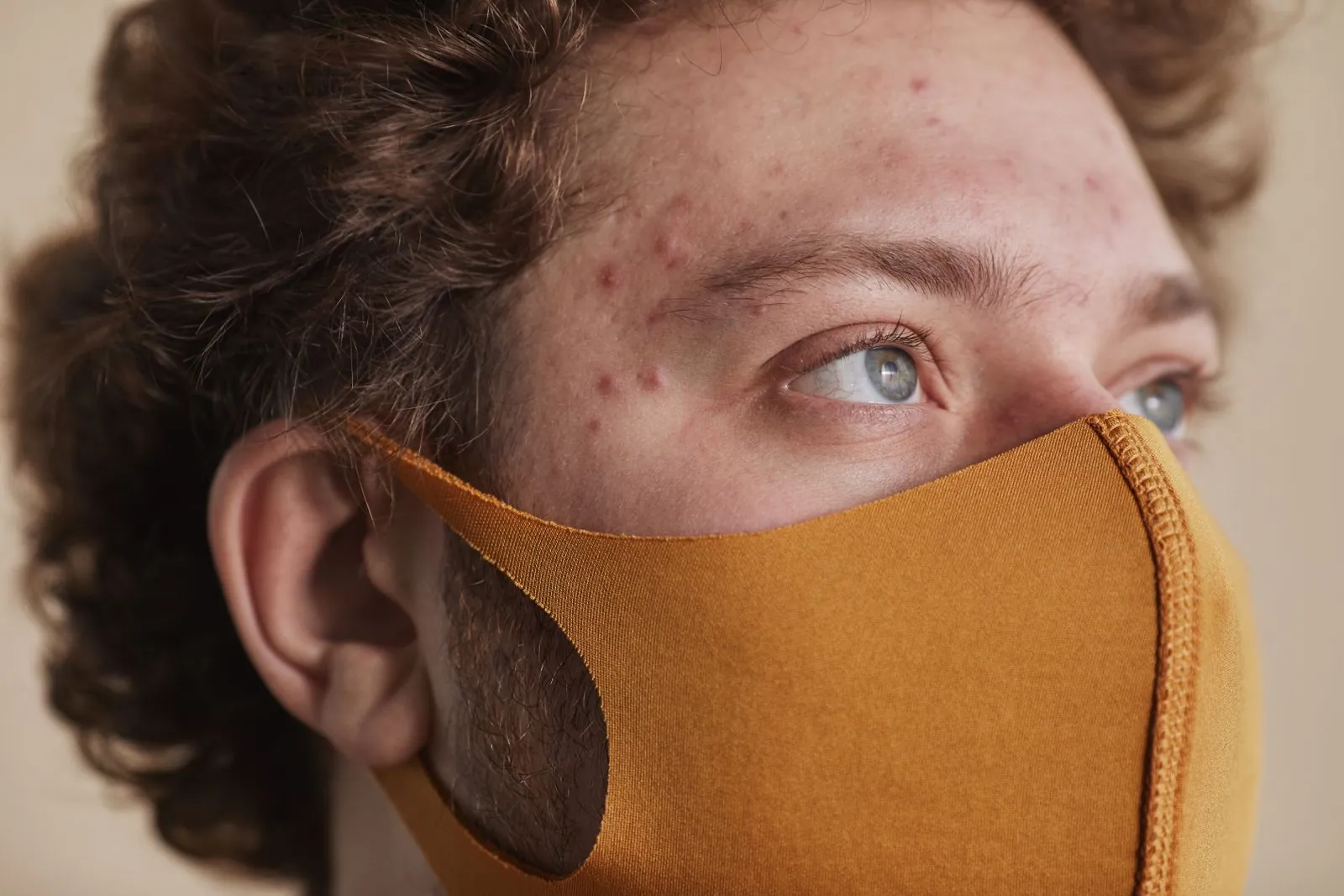
Masks earned this zone its own word during the pandemic: maskne. A 2022 review found that “prolonged mask use determines a hot-humid microclimate on the skin surface, thus modifying sebum production and consequently microbiota” (Spigariolo et al., Journal of Clinical Medicine). Translation: a mask turns your lower face into a tiny greenhouse, and your pores are the crop. If your breakouts sit exactly where fabric sits, you have a friction answer, not an organ answer.
If what’s bothering you on the cheeks is less pimples and more lumpy, uneven surface, that’s a different problem with different fixes, covered in our skin texture guide.
Is jawline and chin acne always hormonal?
No, and this is the biggest myth on the modern map. Hormones genuinely influence this zone, and breakouts there often track the menstrual cycle. But in a 374-woman study, only 11.2% had acne confined to the jawline area, and researchers have directly challenged using breakout location to predict a hormone problem. Location alone cannot diagnose anything.
The evidence-backed half is real. A review in the International Journal of Women’s Dermatology notes that “female patients may more frequently develop lesions on the lower third of the face, especially on the chin and jawline” (Int J Womens Dermatol), and Cleveland Clinic adds that “acne here is likely to be deeper, bigger and more inflamed than acne elsewhere on the face” (Cleveland Clinic).

Then came the study that embarrassed my chart twice in one abstract. In 2015, an international team examined 374 adult women with acne and reported that “most women (89.8%) had acne involving multiple facial zones (cheeks, forehead, mandibular area, temples)”, while “a small subset (11.2%) had acne localized only to the mandibular area”. Their conclusion, word for word: “The stereotype of adult female acne being due to hormonal disturbances presenting as inflammatory acne localized only to the mandibular area was not found in the majority of this large group” (Dreno et al. 2015).
“There is no evidence to suggest that acne around the jaw and chin will accurately predict if a person has a hormonal disturbance.”
Medical News Today
So when should hormones actually be on your list? The same women’s dermatology review is specific: “Endocrine testing is only needed in patients who have other signs or symptoms of hyperandrogenism”, such as unwanted hair growth, very oily skin or hair thinning, with PCOS the most common cause (Int J Womens Dermatol). Breakouts plus those signs is a doctor conversation. Breakouts alone is just acne, standing in a suggestive location.
What does nose acne mean?
Blackheads and whiteheads cluster on the nose because it sits in the center of the T-zone, where pores and oil glands are at their largest and most productive. The old map says the nose reflects your heart; no evidence supports that. Also, many of the dark dots people pick at on the nose are not blackheads at all.
Flat, gray, evenly spaced dots in the pores are usually sebaceous filaments, a normal, self-refilling part of the pore that every nose has. Our sebaceous filaments guide covers how to tell them apart and what actually shrinks their look. I spent years fighting mine like they were an invading army, when they were more like tenants. With a lease. (They renewed.)
How do you actually use an acne pimple face map?
Use the map to generate suspects, not verdicts. Pick the most likely trigger for your zone, change only that one thing, and give it 4 to 6 weeks. Meanwhile treat the acne itself with proven ingredients: salicylic acid, benzoyl peroxide or adapalene. If two to three months pass with no progress, or the acne is deep and painful, see a dermatologist.
The one-change rule matters because changing five things at once teaches you nothing, a lesson I learned by changing five things at once. (New pillowcase, new cleanser, no dairy, new hair gel, and a brief, chart-inspired distrust of my own gallbladder. Something worked. I will never know what.)
While you run the experiment, a hydrocolloid patch can babysit individual spots overnight; our pimple patches guide explains what they can and can’t do. And if you start adapalene or another retinoid and things look briefly worse before better, that’s a known phase with its own rules, covered in the retinol purge guide. None of this requires a chart. [Glances at the junk drawer. The chart hears nothing, because it is a chart.]
Frequently asked questions
Is acne face mapping real?
Partly. The organ-to-zone version has no scientific support. The practical version holds up in specific cases: hair products cause hairline acne, friction aggravates cheeks, the oily T-zone clogs easily, and hormones influence the jawline and chin in some people.
What is the Chinese acne face map?
A roughly 3,000-year-old system that links each facial zone to an internal organ: forehead to liver and digestion, nose to heart, cheeks to stomach and lungs, chin to the reproductive system. No controlled studies support the organ connection.
What does acne on the cheeks mean?
The least of any zone. Dermatologists say cheeks reveal little by themselves. Documented contributors include phone screens, pillowcases, makeup brushes, masks, touching your face and genetics.
Does jawline acne mean a hormone imbalance?
Not by itself. In a 374-woman study, only 11.2% had acne confined to the jawline zone. Doctors only recommend hormone testing when acne comes with other signs, like unwanted hair growth or hair thinning.
Why does my acne come back in the same spot?
The local conditions that caused it – a large oil gland, a product that reaches that spot, repeated friction – usually haven’t changed, so the same pore clogs again. A steady routine with a retinoid or salicylic acid lowers repeat appearances.
When should I see a dermatologist about breakout location?
If acne is deep, painful or scarring, if it hasn’t improved after two to three months of consistent over-the-counter treatment, or if breakouts come with irregular periods, unwanted hair growth or hair thinning.
Your next step
Find your main breakout zone in the table above, pick the single most likely trigger, and change only that for the next 4 to 6 weeks while treating the acne itself with salicylic acid, benzoyl peroxide or adapalene. If your bumps are the small, skin-colored kind that never come to a head, start with our closed comedones guide instead.

Written by the Trusted Skincare Editorial Team
We research at-home beauty devices and skin treatments and link every claim to a published study, a regulator or a named expert. Last updated Thursday 1 October 2026.
Sources
- Cleveland Clinic: What It Means When Acne Is on Certain Areas of Your Face
- Medical News Today: What to know about acne face maps
- American Academy of Dermatology: Are your hair care products causing breakouts?
- Dreno et al. 2015: Large-scale international study of acne in adult females (JEADV)
- A review of diagnosis and treatment of acne in adult female patients (Int J Womens Dermatol 2018)
- Spigariolo et al. 2022: Maskne, the epidemic within the pandemic (Journal of Clinical Medicine)
- Allen-Taintor Dermatology: Is The Acne Face Map Legit?
- SLMD Skincare (Sandra Lee, MD): Acne Face Map by zone
- Image Skincare: The Acne Face Map
- American Academy of Dermatology: Acne, who gets it and what causes it