
On this page
- Dehydration lines vs fine lines vs wrinkles at a glance
- What are fine lines?
- Is it a fine line or a dehydration line?
- Why do fine lines under eyes show up first?
- What causes fine lines around the mouth?
- How do you get rid of fine lines?
- Does microneedling work for fine lines?
- What should you not do about fine lines?
- When does a fine line become a wrinkle?
- Can an at-home device help fine lines?
- Your next step
Quick answer: Fine lines are shallow creases that show up where skin moves most: the eye corners, under the eyes and around the mouth. Some are dehydration lines that fade within a minute of moisturizer. For the rest, daily sunscreen prevents new ones, a retinoid softens them over 16 weeks or more, and microneedling or Botox handles what creams can’t.
We read 24 studies and sources, from a 1986 tretinoin trial to a 2025 microneedling review, so every claim below links to where it came from. (I also promoted the moisturizer I bought at a gas station to Head of Anti-Aging. No interview. No qualifications. It’s doing great.)
Dehydration lines vs fine lines vs wrinkles at a glance
| Dehydration line | Fine line | Wrinkle | |
|---|---|---|---|
| What it is | A surface crinkle from skin that is short on water | A shallow crease, under about 1 mm deep, where skin folds most | A crease deeper than 1 mm that has settled in |
| Where it shows | Forehead, under the eyes, cheeks | Eye corners, under the eyes, around the mouth | Anywhere a fine line was, plus the forehead and between the brows |
| Moves or stays? | Fades with moisturizer, often within a minute | Shows with expression, often disappears when the skin is stretched | Visible at rest, deeper when you move |
| The test | Moisturize, wait 30 seconds, look again | Pinch and release: it comes back | Pinch and release: it never left |
| What helps | Hydration, a humectant like hyaluronic acid | Daily sunscreen, a retinoid, time | Retinoid, microneedling, Botox for movement lines, fillers |
Sources: Mitchel P. Goldman, MD, Cosmetic Laser Dermatology, Westlake Dermatology, Cleveland Clinic, American Academy of Dermatology.
What are fine lines?
Fine lines are the first, shallowest creases in the skin, under about 1 mm deep, that appear where you make the same expression over and over: the outer eye corners, under the eyes, and around the mouth. They can start after age 25. Left alone, with sun and time, they deepen into wrinkles.
“Fine lines are the start of wrinkles and look like small creases on your skin. They’re closer to the surface of your skin, whereas wrinkles are deeper into your skin.”
Cleveland Clinic
Closer to the surface has a number attached. Westlake Dermatology says “Dermatologists define fine lines as measuring less than 1mm in depth, while a wrinkle is any crease that’s deeper than that” (Westlake Dermatology). One millimeter. I have measured exactly one thing in my life to that precision, and it was a shelf, and the shelf is still crooked.
Is it a fine line or a dehydration line?
A dehydration line is a surface crinkle caused by skin that is short on water, and it softens or vanishes with proper hydration. A fine line is a crease in the skin’s structure and stays put. The quick test: apply moisturizer to the area, wait 30 seconds, and look again. Fading means dehydration.
“Dehydration lines appear when your skin is thirsty for moisture. They’re typically found on the forehead, under the eyes, and on the cheeks. Unlike true wrinkles, these lines often vanish with proper hydration.”
Mitchel P. Goldman, MD, Cosmetic Laser Dermatology
Here’s the 30-second version, which is practitioner consensus rather than a trial, so treat it as a sorting hat and not a diagnosis. Cleanse, pat dry, look hard at the lines, then press in a plain moisturizer and count to 30. (I count out loud. My neighbor has stopped asking.) Lines that soften were dehydration lines, and they want water, not war. Lines still sitting there are structural. This is the one meeting where my gas-station Head of Anti-Aging earns the title, because hydration is its entire job description.
The hydration lane has a real trial behind it. In 76 women aged 30 to 60, hyaluronic acid creams around one eye, against a plain cream around the other, improved hydration and elasticity in 60 days, and “Application of low-molecular-weight (LMW) HA was associated with significant reduction of wrinkle depth” (Pavicic 2011). An eye cream earning its keep in two months, with the other eye as the control, and my two eyes have never agreed on anything. If your whole face feels tight, flaky and lined at once, read our guide to dehydrated skin before you buy another serum.
Why do fine lines under eyes show up first?
The skin around your eyes is the thinnest on your face, about 0.5 mm on the eyelids against roughly 2 mm on the cheeks, with little fat beneath it and fewer collagen fibers. It also moves constantly: eyelids blink 15,000 to 20,000 times a day. Thin skin folded that often creases years before the rest of the face.
“The epidermis (the top layer of skin) is about 0.5 mm thin on the upper and lower eyelids, compared to roughly 2 mm on the cheeks or forehead.”
Chris Thiagarajah, MD, oculoplastic surgeon, Denver Eyelid Specialists
Dr. Thiagarajah adds that eyelids “blink 15,000-20,000 times per day” over “very little subcutaneous fat” (Denver Eyelid Specialists). Thin fabric, no padding, folded twenty thousand times a day. I fold a fitted sheet twice a year and it looks worse than that. Cleveland Clinic says you “may first notice crow’s feet when you’re in your 30s” (Cleveland Clinic); the fan at the outer corner has its own guide, crow’s feet and what actually helps, and the creases on the nose when you scrunch are bunny lines. (I scrunched to check. Nose offended.)
Getting rid of fine lines under eyes is the same ladder at a gentler dose (lower and slower here is practitioner consensus), plus sunglasses, because the American Academy of Dermatology says “Wearing sunglasses can help reduce lines caused by squinting” (AAD). Mine live in the glove box of a car I rarely drive. Safe for them, useless for my face.
What causes fine lines around the mouth?
Lines around the mouth come from the ring of muscle that purses, sips and smiles thousands of times a day, working on skin that loses collagen with age. Cleveland Clinic says lip lines usually show in your 40s, earlier with smoking or sun damage. Vertical lip lines and mouth-corner lines respond to retinoids, microneedling and, for the deeper ones, fillers.
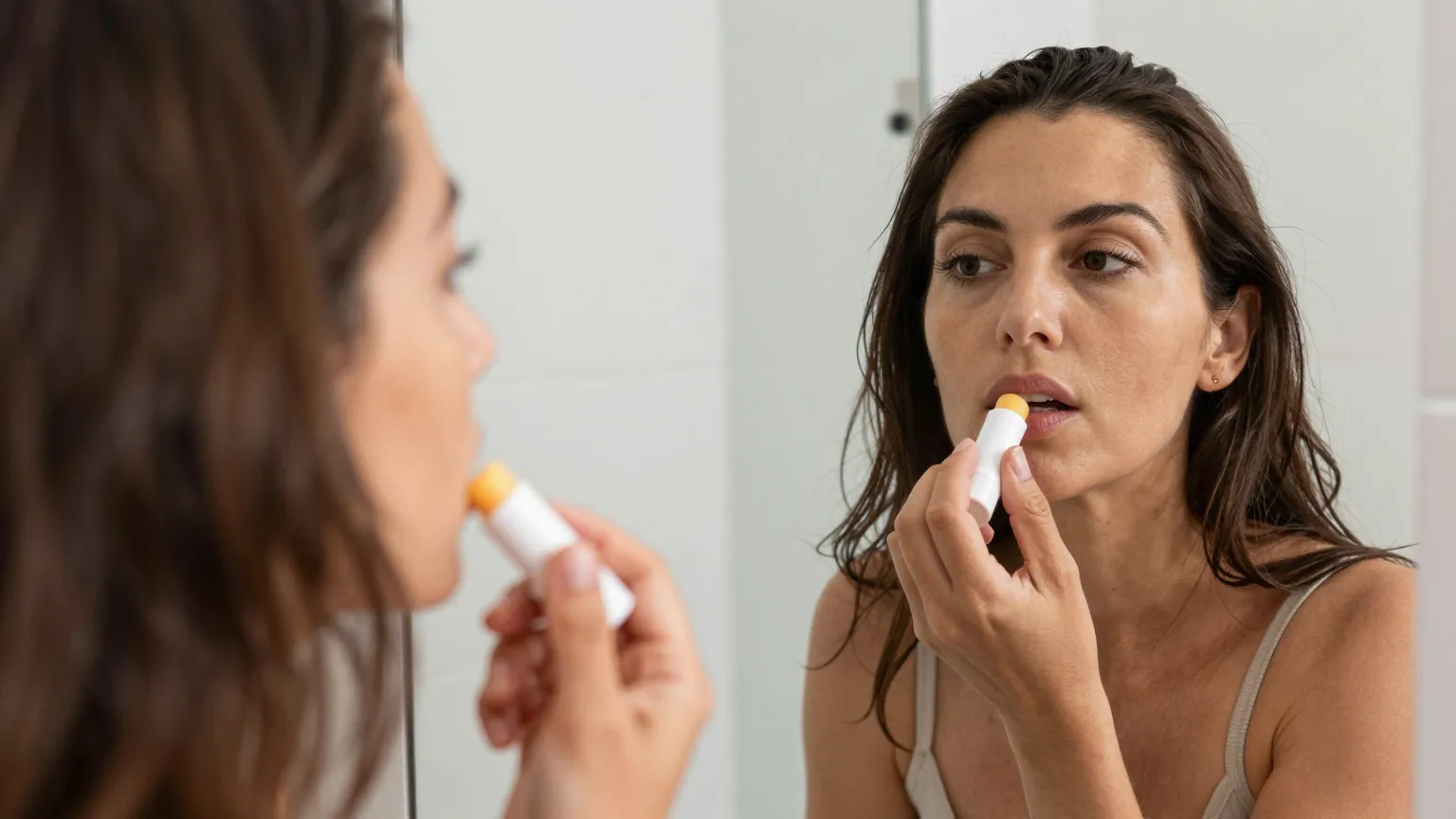
Cleveland Clinic puts the blame plainly: “The underlying cause is activity of the muscle around the mouth, which becomes more active with time” (Cleveland Clinic). Straws, pursing, the face you make reading a group chat. (Mine is a tight little purse. It is accurate.) The same page says “Lip lines usually develop around your 40s”, earlier with smoking or sun-damaged skin (Cleveland Clinic). Nobody puts sunscreen on their top lip, except the people with fewer lip lines.
The upper lip is one of the better-studied spots for microneedling: in ten women aged 50 to 65, two sessions meant “the wrinkles’ severity grade in most patients was greatly reduced” (Fabbrocini 2012). Ten people is a pilot, not a verdict. File it under promising, next to my new year’s resolutions.
How do you get rid of fine lines?
Start with daily broad-spectrum SPF 30 sunscreen, which in a 4.5-year trial stopped measurable skin aging. Add a retinoid at night and judge it at 16 weeks, not 4. Use a hyaluronic acid moisturizer for the dehydration layer. If lines are still there at rest after six months, a dermatologist can offer microneedling, Botox for movement lines, or a peel.
Here’s the honest scorecard, with the column nobody prints. (I asked for one called “by Friday”. The literature declined.)
| Option | What the evidence shows | Realistic timeline |
|---|---|---|
| Daily sunscreen, SPF 30 or higher | 903 adults, 4.5 years: no detectable increase in skin aging, 24% less aging than sunscreen-when-you-remember | Prevents new lines. Doesn’t fade old ones. Works from day one, shows over years |
| Hyaluronic acid cream | 76 women, 60 days, one eye vs the other: better hydration and elasticity, less wrinkle depth with the small-molecule versions | 30 to 60 days for dehydration lines |
| Retinoid, from retinol to tretinoin | 8 trials, 1,361 people: tretinoin beat a plain cream on fine and coarse wrinkles. 14 of 15 faces improved at 16 weeks in the 1988 trial | 12 to 24 weeks before judging. Irritation first, results later |
| Microneedling | 21 studies, 723 people: 83% satisfied, 90% of studies used more than one session | Usually 2 to 6 sessions about a month apart (the count is practitioner consensus) |
| Botox | Blocks the muscle behind lines that show with movement | Takes effect in days, lasts about three to four months |
Sources: Hughes 2013, Pavicic 2011, Huang 2025, Weiss 1988, Foppiani 2025, Clarus Dermatology.
The sunscreen trial is the one I’d tattoo inside my sunglasses. In Nambour, Australia, 903 adults under 55 used sunscreen daily or only when they felt like it, and after 4.5 years “The daily sunscreen group showed no detectable increase in skin aging” (Hughes 2013). Not slower aging. None detectable. [Looks at own sunscreen. It expired. We don’t talk about it.]
Retinoids are the fading step, with the oldest evidence here: a 2025 pooling of eight trials and 1,361 people called tretinoin “a safe and effective treatment for fine and coarse facial wrinkles resulting from photodamage” (Huang 2025). Tretinoin needs a prescription in the US; retinol and retinal don’t, and our retinal vs retinol guide walks the strength ladder. Thirty-seven years of evidence, and I still treat the tube like a dare.
The catch is the first month of flaking and breakouts, the retinol purge, which is why board-certified dermatologist Tina Alster, MD, tells patients to “use the least-intense retinoid formula they can find, and use it every other night to start, slowly building up” (AAD). I started at full strength, nightly, like a hero. The hero peeled. The AAD says “most products take at least six weeks to work. Sometimes it can take three months” (AAD), so the honest window is 12 to 24 weeks, one full season of not checking. [Checks.]
Does microneedling work for fine lines?
Yes, with limits. A 2025 review of 21 studies and 723 people found 83% of patients satisfied, with passing redness as the main side effect, but most studies needed several sessions and used different scoring, so nobody can promise you a percentage. Small trials on upper lip lines and eye-area wrinkles improved after two sessions.
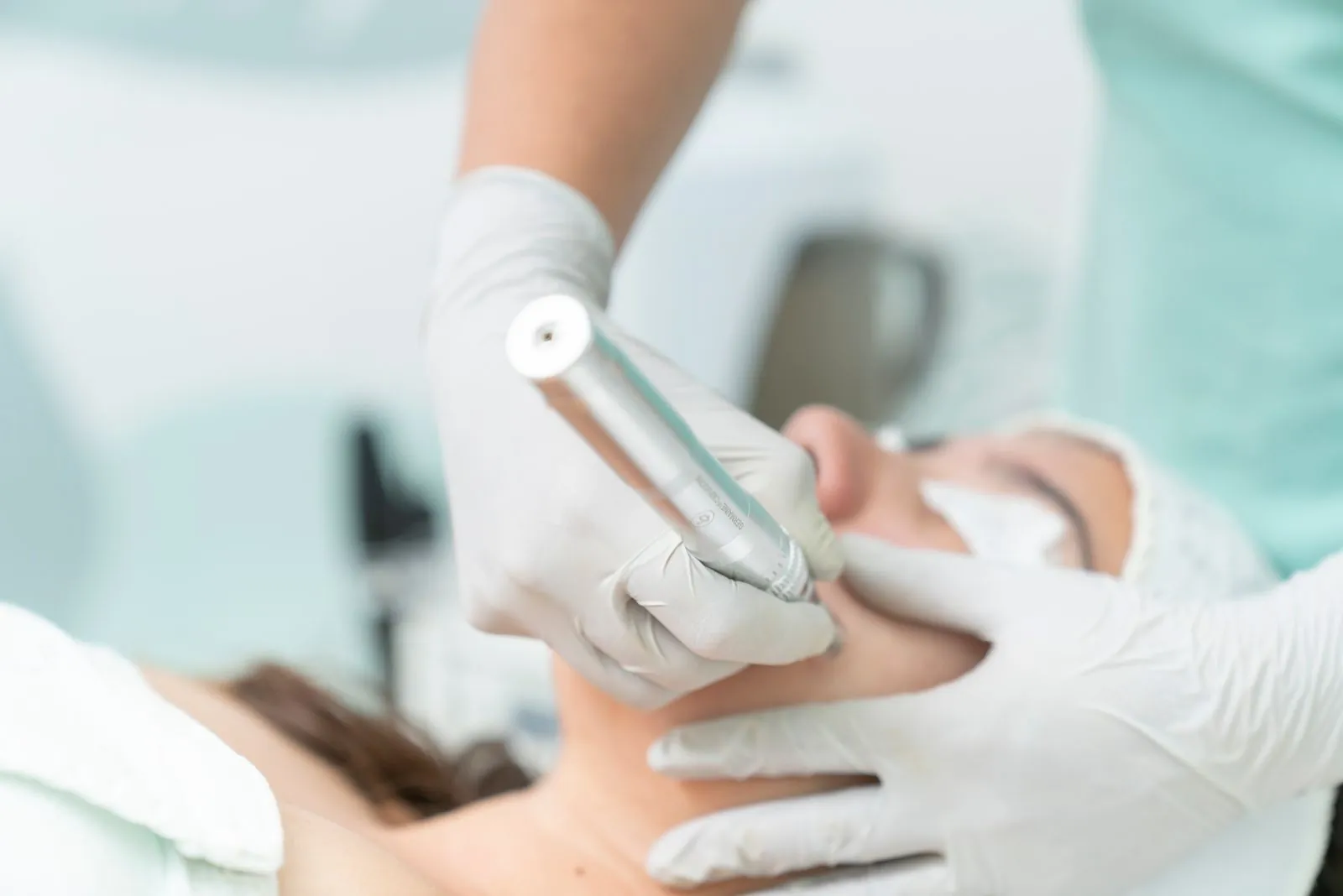
Microneedling is tiny needles making tiny wounds so the skin builds new collagen on the repair, the least relaxing sentence in skincare. The review found “83% of patients reported satisfaction with their treatment”, “transient erythema (6.8%)” as the usual side effect, and that “The majority of trials (90%, 19/21) treated patients with multiple MN sessions” (Foppiani 2025). Its own authors say efficacy still needs standard measuring. A review rating itself promising-ask-again-later, which is also how I’d rate my gym attendance.
For the eye area, the clinic version with radiofrequency through the needles improved wrinkles at rest in 18 people after two sessions, with redness that “resolved within a week” (Lin 2025). Eighteen people, one clinic, no untreated comparison: promising and small. Clinics commonly book three to six sessions a month apart, which is practitioner consensus, so budget for the course, not the first visit.
[Takes off the funny hat.] RF microneedling belongs in a clinic: the FDA said in October 2025 that “RF microneedling is a medical procedure, not a cosmetic treatment, and these devices should not be used at home” (FDA), after reports of burns, scarring and nerve damage.
What should you not do about fine lines?
Don’t scrub, over-exfoliate or stack several actives, since the AAD says irritation makes signs of aging more noticeable. Don’t use products that sting unless a dermatologist prescribed them. Don’t sleep face-down or on one side every night if you can help it. And don’t judge a retinoid before 12 weeks.
“Using too many products on your skin, especially more than one anti-aging product, tends to irritate the skin. This often makes signs of aging more noticeable.”
American Academy of Dermatology, Wrinkle remedies
The over-exfoliation trap: an acid toner, a scrub, a retinoid and a peel pad is not a routine, it’s a pile-on. The AAD is blunt: “Scrubbing your skin clean can irritate your skin. Irritating your skin accelerates skin aging” (AAD). If plain water stings, you’ve overdone it, and our skin barrier repair guide is the way back. Blades count too: dermaplaning at home is fine done gently and a problem done weekly. (I owned four exfoliants at once. The Head of Anti-Aging watched me buy the fourth and said nothing, which is a leadership style.)
Sleep position is the sneaky one. A 2016 review describes “Compression, shear, and stress forces” on the face “in lateral or prone sleep positions”, meaning on your side or face-down (Anson 2016). A review, not a trial, so call it plausible rather than proven. I sleep like a dropped marionette. Back-sleeping is on my to-do list, just under learning to parallel park.
When does a fine line become a wrinkle?
A fine line becomes a wrinkle when it is still there with your face completely relaxed. Dermatologists put the depth line at about 1 mm. The Glogau scale, used in clinics since 1996, calls the early stage “wrinkles in motion” and the next “wrinkles at rest”. Lines that only show when you smile are still on the fine-line side.
Cleveland Clinic says it plainly: “Wrinkles are apparent when you’re at rest, but they may become more noticeable when you move your facial muscles by smiling or frowning” (Cleveland Clinic), and Dr. Richard Glogau’s scale runs from type II “wrinkles in motion” to type III “wrinkles at rest” (Glogau 1996). So the test is the mirror with a straight face, the one you make at a parking meter.
If the line is there with that face, it has graduated, and the AAD explains why: “If you repeatedly contract the same muscles for many years, these lines become permanent” (AAD). That’s where Botox earns its place for forehead wrinkles and frown lines. A graduated line is a receipt for every laugh that got you here, and I keep my receipts.
Can an at-home device help fine lines?
A little, with modest evidence. In a 2022 split-face trial, 32 women aged 35 to 60 finished 12 weeks of a needle-free radiofrequency device at home and saw bigger wrinkle, radiance and skin-thickness improvements than an anti-aging cream on the other side. One small trial. Sunscreen, retinoids and clinic treatments have far stronger evidence.
The trial put the device on one side of each face and a cream on the other, and “the experimental side showed statistically significant improvements in wrinkles, skin radiance, color and thickness” (Shu 2022, full text). Whole-face aging, not fine lines alone, in 32 people. Real, modest, upkeep-sized.
The VEAUTY Dot is that kind of device: 144 electrodes that sit on the skin and never pierce it, surface only, sold as a cosmetic device, about 15 minutes a few times a week. It’s rated 4.8 out of 5 from 1,163 reviews on its own store. Those are customer reviews, not a trial, and results vary. If your lines are already there at rest, a retinoid and a dermatologist will do more, and the Dot is the sofa option for upkeep in between. (The Head of Anti-Aging has been reassigned to Head of Hydration. It reports to sunscreen now. Morale is fine.)
Frequently asked questions
Are fine lines the same as wrinkles?
No. Fine lines are shallow creases under about 1 mm deep that often show only with expression. Wrinkles are deeper and visible with your face at rest. Fine lines usually become wrinkles over time without sun protection.
Can fine lines go away?
Dehydration lines can disappear with hydration. True fine lines can be softened with a retinoid over 12 to 24 weeks and kept from deepening with daily sunscreen, but they rarely vanish completely.
How do you get rid of fine lines under the eyes?
Sunscreen to the lash line, a hyaluronic acid eye cream, and a low-strength retinoid a few nights a week, started slowly because the skin there is about 0.5 mm thick. For lines that stay at rest, a dermatologist can offer microneedling or Botox.
What age do fine lines start?
Cleveland Clinic says fine lines can start after age 25. Crow’s feet are usually first noticed in the 30s and lip lines around the 40s, earlier with sun exposure or smoking.
Is retinol or hyaluronic acid better for fine lines?
They do different jobs. Hyaluronic acid hydrates and softens dehydration lines within weeks. Retinoids rebuild over months and have the stronger evidence for true fine lines. Many people use both: hyaluronic acid in the morning, retinoid at night.
Your next step
Do the 30-second moisturizer test tonight, then put on sunscreen every morning from tomorrow. If the lines stayed, start the mildest retinoid you can find every other night and judge it at week 16. If lines are still there with your face relaxed after six months, book a dermatologist and ask about microneedling.

Written by the Trusted Skincare Editorial Team
We research at-home beauty devices and skin treatments and link every claim to a published study, a regulator or a named expert. Last updated Wednesday 7 October 2026.
Sources
- Cleveland Clinic: Wrinkles and fine lines
- Cleveland Clinic: Lip lines
- Mitchel P. Goldman, MD: Do I have fine lines or wrinkles? (Cosmetic Laser Dermatology)
- Westlake Dermatology: Fine lines vs wrinkles
- Chris Thiagarajah, MD: Why is eyelid skin the thinnest in the body?
- American Academy of Dermatology: Wrinkle remedies
- American Academy of Dermatology: 11 ways to reduce premature skin aging
- Hughes et al. 2013, sunscreen and prevention of skin aging (Annals of Internal Medicine)
- Weiss et al. 1988, topical tretinoin improves photoaged skin (JAMA)
- Huang and Lee 2025, tretinoin for photodamaged facial skin: meta-analysis
- Pavicic et al. 2011, hyaluronic acid creams of different molecular weights for wrinkles
- Foppiani et al. 2025, microneedling for facial rejuvenation: systematic review
- Glogau 1996, aesthetic and anatomic analysis of the aging skin
- Shu et al. 2022, at-home RF device: randomized split-face trial